Your donation is much appreciated. It will be put to good use.
Julie
Links to
Wholesome Resources for Mind-Body Mastery through Yoga, Meditation, Guided Imagery, Stress Relief, Wellness


Your donation is much appreciated. It will be put to good use.
Julie
Links to

Eye Movements
After a while, eye muscles tire out and it becomes harder to focus. To prevent this from happening, you can practice these eye movements. They will strengthen your eye muscles and eyesight and stimulate the brain. Visual, auditory, and sensory perception can increase. Do them sitting up, standing, or lying down.
Here’s How
Chidakasha: Quieting the Mind by Stilling the Eyes Using the sense of sight is a very effective centering technique. Doing so can have a beneficial effect on the brain as well. Have you ever noticed that you can still see even with your eyes closed? All that is needed is to try. You might see it as darkness, designs, colors, spots, or a combination. It does not matter. What matters is passively focusing your attention on what is being seen and watching it as it changes. Have fun watching whatever appears as it comes and goes on the inside screen of your closed eyelids. This brings you into the moment and quickly settles down mental restlessness. Yogis refer to watching this inner space of consciousness as Chidakasha. ( Yoga Nidra for Complete Relaxation & Stress Relief, page 115)
 Julie Lusk, MEd, E-RYT 500, has more than 35 years of expertise in stress relief, yoga, relaxation training, guided imagery, and meditation as an international author, recording artist, and workshop leader. Julie is the author of Yoga Nidra for Complete Relaxation and Stress Relief, Yoga Meditations, two volumes of 30 Scripts for Relaxation, Imagery and Inner Healing, and Desktop Yoga®. Her audio downloads and CDs include Wholesome Relaxation, Power of Presence, Yoga Nidra Essentials, Blue Moon Rising, and many others. Learn more at WholesomeResources.com
→ Page Includes Complete Chakra Chart with helpful instructions
Each of us has has seven primary subtle energy centers called chakras. Chakras are considered as one of the most important  indicators of a person’s health and well-being.
Traditionally, the seven primary chakras are described as spinning wheels of subtle energy that span from the base of the spine to the crown of the head.
Chakras guide the developmental stages of our body, mind, and emotions, and awaken our potential as spiritual beings. The chakras are referenced in the yogic wisdom books dating back five thousand years. Many medical, mental health, spiritual and mind-body professionals now seek to understand and apply the ancient knowledge of the chakras within their field of expertise.
Each of the seven chakras is associated with and has an influence on physical locations in the body as well as on adjacent muscles, organs, glands, and nerves. Yogis believe they house the guiding intelligence of prana, the universal energy of life.
Furthermore, each is related to stages of psychological growth and human development and has lessons to guide us through life that are integral to our soul’s journey.
Because they are energetic rather than physical structures, they are not considered to part of our physical anatomy. They can be described as psycho-energetic or psycho-spiritual centers located in the subtle body. Like magnetism existing within an iron magnet, they exist within the body without having a physical presence.
Each chakra is associated with color, crystals, sounds, goddess archetypes, yoga postures, healing and balancing colors, an element, and sounds.
Establishing and maintaining balance throughout all the chakras is optimal since one chakra is not particularly better than the others. Chakra energy currents move both vertically and horizontally. When the chakras are unbalanced with either excessive or deficient energy, the result is physical, mental, emotional or spiritual difficulties. Fortunately, a wide range of techniques exists to open, align, and activate the chakras.
The chakra chart provides information to further your understanding and growth. It was originally published in Yoga Meditations: Timeless Mind-Body Practices in 2005 and is continually updated to include more information.
This Chakra Chart (C) is for personal use only and not duplication. It is reprinted with permission from Julie’s Yoga Meditation book. Order your own beautiful 8.5 x 14″ full-color laminated chart below. Volume orders are welcome. Contact us.
How to use the Chakra Chart for healing and balancing yourself
Begin by familiarizing yourself with the names, locations, and characteristics of each chakra. Here are some ideas for getting started.

Don’t be mistaken by seeing this information boxed into columns and rows. The lines are there to help clarify the information. Think of it as an intermingling or as a gradual blending. It’s somewhat like how the colors in a rainbow gradually transform from one shade to another and at the same time a color can stand on its own.
Ultimately, there is no separation. We are in a unified field of oneness that is as directionless and timeless as it is spacious. http://JulieLusk.com
Yoga Meditations features the full chakra chart, guided meditations for each chakra, a full description and picture of a yoga posture for each chakra as well as all the other information described below.


Chakra-Based Guided Meditations
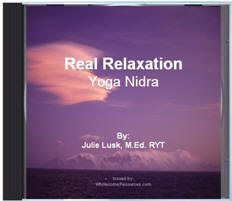
Real Relaxation Yoga Nidra takes you into a deeply relaxing and powerful restful state of being fully aware while being in the state of deep yogic sleep. It helps with balancing chakra energy, and can improve immunity, heart health, relieve stress and give you inner peace and balance.
Get it from Amazon, iTunes, Spotify & other online
stores.
Handy Links
Make positive contact with others. At parties, make sure you have a good conversation with several people. If parties aren’t your bag, make contact in some other situation (a neglected neighbor? with a religious group?)
If your friend or family list is too short, look around for others in the same boat. Try volunteering at Meals on Wheels or the crisis shelter. Someone in your community needs your love. Reach out to others – for both of your sakes.
How are you reaching out during the holidays? What’s your style? Please comment below.
There was a saint who asked a snake not to bite but to love everyone.
The snake agreed.
But then many people threw things at the snake.
The next time the saint saw the snake, he noticed that the snake was all battered up. So, the saint asked “What in the world happened to you?”
The snake replied, “You asked me to love everybody and not to bite, and this is what happened.”
“I didn’t say not to hiss.”
Doesn’t Ramakrishna’s story have a lot to consider? How many times have we tried to “be good” but it came back to bite us. Setting boundaries can be quite helpful.
I remember telling this story while teaching a yoga class while we were doing the cobra pose. It seemed quite natural to hiss during the yoga posture so we did. Hissssssss!
The next week, one person said that she tried hissing at work and asked “Do you want to know what happened?” Of course I did. She said that she spoke up about something that had been bugging her and it lead to her getting a promotion!” Obviously, she hissed quite skillfully.
