To Improve Your Memory, Concentration & More
Julie Lusk, M.Ed., E-RYT-500
Wholesome Resources for Mind-Body Mastery through Yoga, Meditation, Guided Imagery, Stress Relief, Wellness


Who couldn’t use some extra shut-eye? Sleep is vital to our health and sleep experts tell us we need an average of eight hours at a shot.  Even if there’s time for sleep, many of us have trouble getting to sleep or staying asleep. Let’s take a look yoga nidra and sleep. Yoga nidra can help in replenishing ourselves, can be used as a natural sleep aid, and more.
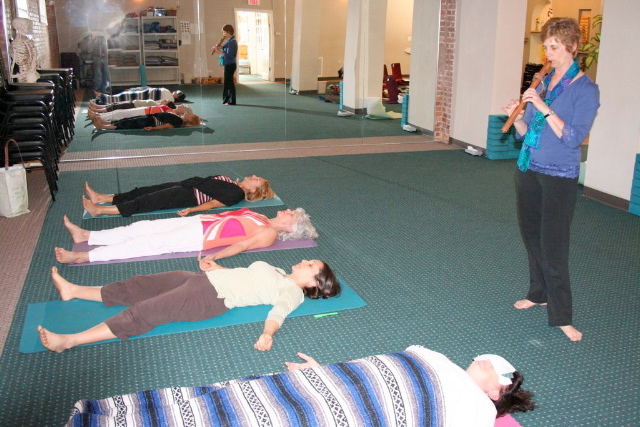
Yoga nidra means “yogic sleep” and has many documented benefits for your body, mind, and spirit. It is when your bodymind is actually in deep sleep but with one big difference – you remain consciously aware. This is done by going through a series of techniques to systematically get physically, energetically, mentally, emotionally relaxed. In addition, yoga nidra sparks intuition, unconditional joy, and a timeless, spacious sense of being. Witness consciousness is experienced and even surpassed. Due to the fertile brainwave states experienced, it’s also entirely possible to make positive behavior and personality changes. See the yoga nidra FAQ on setting intentions and sankalpas here.
In fact, while not a substitute for actual sleep, one hour of yoga nidra practice is equivalent to four hours of sleep. This is due to the series of brain waves experienced along the way. (Saraswati 1998, Kumar 2008) With practice, you’ll eventually be able to enter the delta brainwave state but remain aware. It resembles what it feels like to be on the verge of being awake and asleep. The conscious experience of deep sleep is what makes it so restorative and unique.
Yoga nidra can also be practiced at bedtime as a sleep aid. Layer after layer of stress is cleared out so it doesn’t follow you to bed and disturb sleeping. Using yoga nidra techniques as a sleep aid should not be confused with the yoga nidra experience itself. Be careful or you will find it difficult to practice yoga nidra itself and will fall into deep sleep instead.
Yogic sleep is also a play on words of sorts. It refers to how most of us are walking around “asleep” and unaware of our True Self, the indestructible aspect in each of us that is already peaceful, joyful, wise, soulful, luminous, and loving. Whereas, the yogi is awake to one’s True Self no matter what the state of consciousness – waking, dreaming, deep sleep. Realizing this enables us to recognize the true nature of oneself and reality so we are not swayed by the changeability and unpredictability of thoughts, feelings, beliefs and such. Yoga nidra helps us experience and realize this.
In short, yoga nidra is super sleep!
Like all worthwhile things, regular practice yields the best results.
Get Related article:
Get yoga nidra downloads here.
 Sleep Well | Yoga Nidra CD Use deep relaxation, soothing flute music & ocean waves to go to sleep. "I slept like a log." Downloads available. By Julie Lusk, Yoga Nidra Meditations author.

Yoga Nidra Essentials CD Find your calm spot. Brighten your energy. Enjoy a more meaningful life. Experience 6 levels of relaxation. Reclaim optimal health for your body, mind & heart. Laura says "My focused mind easily. I was 100% worry-free. It's wonderful." By Julie Lusk, 6-time author. Digital downloads available.
Julie Lusk, MEd, E-RYT 500, has over 35 years of expertise in stress relief, yoga, relaxation training,  guided imagery, and meditation as an international author, recording artist, and workshop leader. Julie is the author of Yoga Nidra for Complete Relaxation and Stress Relief, Yoga Meditations, two volumes of 30 Scripts for Relaxation, Imagery and Inner Healing, and Desktop Yoga®. Her CDs include Wholesome Relaxation, Power of Presence, Blue Moon Rising, and many others. Learn more at WholesomeResources.com
by Julie Lusk

Julie Lusk
Whole Person Associates Publisher
Becoming Relaxed
The cornerstone of all guided imagery work lies in the ability to relax the body, mind, and emotions. This is true whether you would like to awaken your intuition, communicate with your inner guide, connect with nature, or benefit from the healing visualizations. You will be wasting your time if you don’t relax first.
Practice the following exercises until you become comfortable doing them. The method used for relaxing isn’t important; being able to relax is. Relaxation opens the door to your inner resources. Try out each exercise several times and choose the ones that work best for you.
After you’ve mastered the relaxation exercises, explore the different types of guided visualizations in the other sections of this book, or of those from volume 1.
Nature and the Environment
This section contains a variety of guided meditations that will help deepen your ability to relax and sharpen your ability to visualize, whether you visualize by using your imagination to see, feel, smell, or hear the scenes described. When you practice using all your senses, your experience will be enriched.
Getting in touch with nature is soothing, inspiring, and healing. To get the most out of these visualizations, first take the time to thoroughly relax. Remember to briefly describe the content of the guided visualization to the people you are working with. If a particular setting makes anyone uncomfortable, select a different script.
Inner Answers
Using the guided imagery exercises in this section will help you listen to what you already know. In other words, you will awaken your intuition to help you be consistent and in alignment with your own inner, individual truth.
These scripts are written to unlock your creative potential, provide you with insights, help you see patterns and possibilities, and understand yourself better. In order for this to happen, it is crucial to relax your body and quiet your mind first. So be sure to use a relaxation exercise whenever you are instructed to do so.
Read Awakening Intuition by Frances E. Vaughan for more information about accessing your intuitive self.
Healing
The mind and body are one, and what you believe and feel are reflected in your body. Sometimes your thoughts may lead to illness, aches, and pains; and other times, they can lead to exhilarating feelings of joy, pleasure, and peacefulness. Likewise, the condition of your body and the way it is feeling affect your thoughts. This is why it is impossible to worry when you feel relaxed.
Much of the benefits derived from the following healing imageries come from the necessary first step of calming and centering the body and mind. Therefore, it is important to perform a relaxation exercise whenever a script calls for one. Read the works of Bernie Siegel, Jeanne Achterberg, Joan Borysenko, Patrick Fanning, and Deepak Chopra for an in-depth look at how and why healing imageries work.
Personal Growth
Many people find it hard to make decisions, and many others find it difficult to make positive lifestyle changes. If this is true for you or your clients, try out these guided visualizations. Give your body and mind the chance to work for you instead of against you.
Read Creative Visualization and Living in the Light by Shakti Gawain for a description of the principles used in these scripts.
As always, be certain to use a relaxation script whenever advised to do so, and feel free to modify these scripts to fit your situation.
How’s Your Sleep?
Are you getting enough sleep? Are you tired of being tired? Could you be suffering from sleep deprivation? Well, you’re not alone. Most of us don’t get enough sleep. I don’t know about you, but it’s just irresistible to stay up late, even when I must get up early the next day.
Our busy lives make it so tempting to skimp on sleep. Lots of us have trouble falling asleep or staying asleep. Have you ever felt half-awake and half-asleep all night, here’s an explanation of why that happens with suggestions to help.
The American Academy of Sleep Medicine recommends 7 hours of sleep in every 24 hours for adults. It’s nine to 12 hours for children 6 to 12 years old and teens need eight to 10 hours daily on a regular basis. Establishing good sleep hygiene habits are important to getting a full night’s sleep.
Benefits of Sleep
Getting enough sleep helps normalize mood, improves concentration, memory consolidation, and helps pain management. It improves performance and lowers the risk of having an accident. Sleep is good for your skin and your sex drive. It lowers cortisol, the stress hormone, resulting in better appetite control and weight loss. Getting enough sleep helps regulate glucose levels, supports heart-health and contributes to a healthy immunity. Recent NIH research reveals that sleep is needed to remove the daily buildup of waste and neurotoxins from the brain. Researchers are very interested in this since these neurotoxins are elevated in Alzheimer’s patients. It is thought that the glymphatic system rinses and flushes these neurotoxic molecules from the brain nightly during deep sleep. This clearing process seems to be more effective when sleeping on one’s side, according to a study conducted at the University of Rochester Medical Center. Here’s more information on side-sleeping.
Sleep Solutions – Yoga Style
The art and science of yoga has plenty to offer including postures, breathing techniques, meditation practices, and lifestyle recommendations for sleep improvement. To further ease one’s mind, yoga’s wisdom teachings are helpful for gaining a healthy perspective on everything from handling life’s ups and downs to living with more meaning and purpose. Furthermore, it addresses age-old questions like “Who am I?” and “What is my true nature?”
Students often say that they get their best sleep on the nights they attend yoga class. Having a regular personal home practice is ideal. Here are some of the many ways that yoga supports healthy sleep.
Part 1 – Breathe out through your nose to the count of four.
Part 2 – Breathe in through your nose to the count of four.
Part 3 – Hold your breath to the count of four.
Repeat the whole process for a few minutes or until the desired effect happens.
Yoga nidra can also be used as a natural sleep aid at bedtime. It eliminates layer after layer of tension and stress, allowing you to drift comfortably off to sleep and stay asleep. It’s like drinking a cup of comfort. More on this here.
Watch this short video on how yoga nidra helped her insomnia.
One hour of yoga nidra practice approximates four hours of sleep. This is due to the series of brain wave states experienced during yoga nidra (Saraswati 1998, Kumar 2008). Therefore, yoga nidra can help address sleep deprivation and renew your energy. The conscious experience of deep sleep is what makes it so restorative and unique. Due to the fertile brainwave states experienced, it’s also entirely possible to make positive behavior and personality changes. See the yoga nidra FAQ on setting intentions and sankalpas here. Remember, yoga nidra is not intended to be a substitute for sleep.
How to Experience Yoga Nidra:
Like all worthwhile things, regular practice yields the best results. It’s as easy as 1-2-3.
Sweet Dreams!
Sleep Well | Yoga Nidra CD Use deep relaxation, soothing flute music & ocean waves to go to sleep. "I slept like a log." Downloads available. By Julie Lusk, Yoga Nidra Meditations author.
Julie Lusk, MEd, E-RYT 500, has more than 35 years of expertise in stress relief, yoga, relaxation training, guided imagery, and meditation as an international author, recording artist, and workshop leader. Julie is the author of Yoga Nidra for Complete Relaxation and Stress Relief, Yoga Meditations, two volumes of 30 Scripts for Relaxation, Imagery and Inner Healing, and Desktop Yoga®. Her audio downoads and CDs include Wholesome Relaxation, Power of Presence, Blue Moon Rising, and many others. Learn more at WholesomeResources.com
What a pleasure to specialize in balancing and strengthening the body-mind-spirit connection through yoga, meditation, positive relaxation, and guided imagery. I feel so fortunate to have discovered yoga and meditation as a young woman in the 1970’s and to continue to study and practice till now. What a joy it has been to teach all these years and to be the author of the many books and recordings listed below on yoga nidra, meditation, guided imagery and similar practices.
My professional counseling training, certification, and work has been invaluable, providing me with an enriching perspective on mind-body interventions. Professionally, I have been a regional director for a large hospital-based holistic health and wellness program, director of health management and wellness at a well-known medical clinic, an assistant dean of students for career planning and placement at a college, director of special services at a community college, and an educational awareness counselor. Thousands have been touched through my volunteer work.
Most of all, I love sharing all this with others. This has given me a practical sensibility of what works and what doesn’t as well as all the benefits that happen. It’s a real joy for me to teach others as a teacher and trainer.
Graciously,
Julie Lusk, M.Ed., E-RYT-500


 White Lotus Foundation – Advanced Teacher Training, 1996
 M. 1995; Bill O’Hanlon,