Good job!
Thank you for registering for a SoulCollage workshop.
You will get more details and directions prior to it by email.
Click here to contact Julie Lusk in advance.
See you soon!
Julie Lusk
Wholesome Resources for Mind-Body Mastery through Yoga, Meditation, Guided Imagery, Stress Relief, Wellness


Good job!
Thank you for registering for a SoulCollage workshop.
You will get more details and directions prior to it by email.
Click here to contact Julie Lusk in advance.
See you soon!
Julie Lusk

Good to the Bone is a Yoga Journal article about using yoga and diet to help with the prevention and treatment of bone loss (osteopenia – osteoporosis). The article describes the yoga postures listed in the table below that increased bone strength in 85% of the study participants with a 10-minute sequence that was practiced for a 2-year period. Each posture was held for only 20-30 seconds each. The article, Good to the Bone, is worth the read. Here is the pilot study detailed in the article.
The Twelve-Minute Daily Yoga Regimen Reverses Bone Loss is the full study that was published in Topics of Geriatric Rehabilitation, a peer-reviewed journal. It followed 741 patients over a 10 year period. It showed that yoga improved bone mineral density (BMD) in every-two-year follow-up study that followed. Impressive, eh? Watch the video below to get instructions on what to do along with more info on Dr Fishman’s book and CD. Dr Fishman teaches a weekly zoom class where he teaches the 3 sequences for reversing bone loss. It’s worth registering for.
The posture sequence below flows nicely and incorporates the recommended postures in the pilot study. It’s very important to practice a combination of balancing postures and ones to strengthen bones and muscles. The sequence can also be done in reverse order, beginning with the standing poses, ending lying down in the supine poses and Shavasana. As always, remember to b-r-e-a-t-h-e fully and completely, slowly and deeply. Get all the details here.
PDF Downloads
| English Name | Sanskrit Name | Purpose |
| Bridge Pose | Setu Bandha Sarvangasana |
Bone strength |
| Cobra | Bhujangasana |
Bone and muscle strength |
| Locust | Salabhasana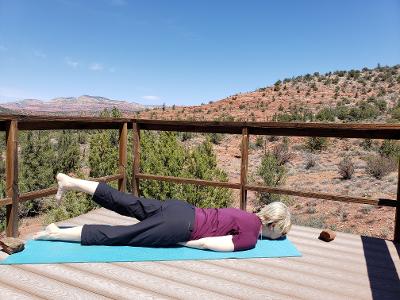  |
Bone and muscle strength |
| Sunbird
Alternate and hold arm and leg lifts from the Table Pose |
Surya Bakāsanasana |
Bone strength and balance |
|
Plank Pose (or variation) |
Kumbhakasana
|
Bone strength and balance |
| Downward Facing Dog
|
Adho Mukha Svanasana |
Bone and muscle strength |
| Mountain Pose | Tadasana |
Bone strength and balance |
| Chair Pose | Utkatasana |
Bone strength |
| Tree Pose | Vrksasana  |
Bone strength and balance |
| Warrior Pose I |
Virabhadrasana I |
Muscle strength |
| Warrior Pose II | Virabhadrasana II
|
Muscle strength |
| Relaxation Pose | Savasana |
Strengthen bones, muscles, balance, and focus. |
As usual, please consult your health care provider and a qualified yoga educator for their recommendations for your needs. This is not intended to be a substitute for appropriate medical care.
Have fun and good luck!
Learn to play the Native American flute! Lessons will get you off on a good note.
Focus on whatever you like. We can cover the basics, embellishments, and how to improvise or learn songs. We will follow your interests from there by delving deeper into playing the flute. She can also get you started playing the reverie harp, tuning forks, tongue drums, and singing bowls. It’s fun and fulfilling.
Lessons are 45-minutes in length. They are given in-person and on Zoom. Zoom lessons are recorded for you to download.

About your Teacher
Julie loves music. She started playing classical flute when the Lusks owned a music store many years ago. She began playing Native American flutes about 10 years ago. Before that, she took piano lessons from elementary school through college.
She delights in playing Native flutes for her yoga and meditation students and is happy to show others how to play joyfully. Julie also plays harmonium, Tibetan bowls, chimes, didgeridoo, drums, and the harp. Julie was a Drums for Fun member for 15 years.
Training
Handy Links


 You’re invited! Please come to our annual Holiday Rescue for Relaxation and Renewal on Tuesday, Dec. 28 at 7 pm at the JCS Pavilion located at 5361 S. Milford Rd., Milford, OH
It’s always a blast to come together, gather around the fireplace, and enjoy yoga together.
Please come and bring your friends. It’s by donation and everything collected will be given to the JSC to help them serve even more people and as a token of our appreciation.
Our regular schedule begins the week of January 10. Visit this link for details on the yoga classes in Milford, OH, Anderson, OH and more.
Many thanks to Dan Leven for sharing this Loving Kindness Facelift. He was inspired by Sharon Salzberg’s book, Real Love.
As he puts it, “It begins with “may my face be happy, may my face be peaceful.” And then you continue moving through each body part wishing them well in this way… “may my neck be happy, may my neck be peaceful … may my shoulders be happy, may my shoulders be peaceful,” and so on. You open your heart’s kindness to your whole body (including your own heart).”
It’s a great way to start and end the day. I love it. I really go to town with spreading happiness and peace throughout my entire body. I enjoy coming up with new places to shower with loving kindness with each practice such as for my brain, blood, eyes and ears – even my hair. Before long, it’s going out to family, friends, pets, strangers and to all kinds of situations. This meditation is especially handy when my attention is restless since it lets me jump all around. It can be any length too – long or short. It sure feels uplifting.
Experience the Lovingkindness Facelift. It’s a replay from one of our yoga nidra on zoom classes.
Dan goes on to explain the science underpinning it. He says, “the vagus nerve is a core part of our parasympathetic nervous system that has two branches. One branch is associated with surviving in a perceived life or death situation where our whole body slows down, feigning death (a primitive survival mechanism). The other branch is about helping us relax and soften into the loving support of others and is associated with the release of oxytocin (the cuddle or bonding molecule). Both branches are about our relationship to “others, “that being dangerous “others” or safe and loving “others.”
Here’s the kicker he reports, “the vagus nerve has many fibers that connect to our facial muscles where we reveal our emotions through a plenitude of expressions. Scientists have logged 21 different emotional expressions that register within the face and there are 8 universal emotional facial expressions that you don’t need a translator to interpret. So our face can register the vagal response from shock and terror, like a deer in the headlights of a moving car (survival vagus nerve), to happiness and peace, like a contented Buddha face (loving vagus nerve)! However, we can also create the response as we bring happiness and peace to our faces!”
So the KEY point, according to Dan, “is that as you invite or train your facial muscles to discover happiness and peace you are strengthening the relaxation response that’s linked to feeling supportive or loving connection with others -to feeling safe in the world.”
Come on – Give it a shot!


