Good job!
Thank you for registering for a SoulCollage workshop.
You will get more details and directions prior to it by email.
Click here to contact Julie Lusk in advance.
See you soon!
Julie Lusk
Wholesome Resources for Mind-Body Mastery through Yoga, Meditation, Guided Imagery, Stress Relief, Wellness


Good job!
Thank you for registering for a SoulCollage workshop.
You will get more details and directions prior to it by email.
Click here to contact Julie Lusk in advance.
See you soon!
Julie Lusk

Good to the Bone is a Yoga Journal article about using yoga and diet to help with the prevention and treatment of bone loss (osteopenia – osteoporosis). The article describes the yoga postures listed in the table below that increased bone strength in 85% of the study participants with a 10-minute sequence that was practiced for a 2-year period. Each posture was held for only 20-30 seconds each. The article, Good to the Bone, is worth the read. Here is the pilot study detailed in the article.
The Twelve-Minute Daily Yoga Regimen Reverses Bone Loss is the full study that was published in Topics of Geriatric Rehabilitation, a peer-reviewed journal. It followed 741 patients over a 10 year period. It showed that yoga improved bone mineral density (BMD) in every-two-year follow-up study that followed. Impressive, eh? Watch the video below to get instructions on what to do along with more info on Dr Fishman’s book and CD. Dr Fishman teaches a weekly zoom class where he teaches the 3 sequences for reversing bone loss. It’s worth registering for.
The posture sequence below flows nicely and incorporates the recommended postures in the pilot study. It’s very important to practice a combination of balancing postures and ones to strengthen bones and muscles. The sequence can also be done in reverse order, beginning with the standing poses, ending lying down in the supine poses and Shavasana. As always, remember to b-r-e-a-t-h-e fully and completely, slowly and deeply. Get all the details here.
PDF Downloads
| English Name | Sanskrit Name | Purpose |
| Bridge Pose | Setu Bandha Sarvangasana |
Bone strength |
| Cobra | Bhujangasana |
Bone and muscle strength |
| Locust | Salabhasana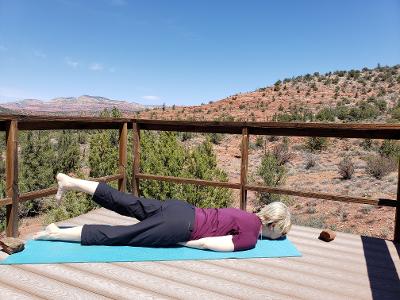  |
Bone and muscle strength |
| Sunbird
Alternate and hold arm and leg lifts from the Table Pose |
Surya Bakāsanasana |
Bone strength and balance |
|
Plank Pose (or variation) |
Kumbhakasana
|
Bone strength and balance |
| Downward Facing Dog
|
Adho Mukha Svanasana |
Bone and muscle strength |
| Mountain Pose | Tadasana |
Bone strength and balance |
| Chair Pose | Utkatasana |
Bone strength |
| Tree Pose | Vrksasana  |
Bone strength and balance |
| Warrior Pose I |
Virabhadrasana I |
Muscle strength |
| Warrior Pose II | Virabhadrasana II
|
Muscle strength |
| Relaxation Pose | Savasana |
Strengthen bones, muscles, balance, and focus. |
As usual, please consult your health care provider and a qualified yoga educator for their recommendations for your needs. This is not intended to be a substitute for appropriate medical care.
Have fun and good luck!
Learn to play the Native American flute! Lessons will get you off on a good note.
Focus on whatever you like. We can cover the basics, embellishments, and how to improvise or learn songs. We will follow your interests from there by delving deeper into playing the flute. She can also get you started playing the reverie harp, tuning forks, tongue drums, and singing bowls. It’s fun and fulfilling.
Lessons are 45-minutes in length. They are given in-person and on Zoom. Zoom lessons are recorded for you to download.

About your Teacher
Julie loves music. She started playing classical flute when the Lusks owned a music store many years ago. She began playing Native American flutes about 10 years ago. Before that, she took piano lessons from elementary school through college.
She delights in playing Native flutes for her yoga and meditation students and is happy to show others how to play joyfully. Julie also plays harmonium, Tibetan bowls, chimes, didgeridoo, drums, and the harp. Julie was a Drums for Fun member for 15 years.
Training
Handy Links


Free Audio
Classes
Audios
Books
Handy Yoga Nidra Links
by Julie Lusk

“I use this book at work to run meditation groups. It is very diverse so that I have many choices to chose from based on my client population. I had another copy of it but used it so much it finally fell apart, this is a replacement.” Posted July 28, 2009, 10:44 AM EST
[WPCR_INSERT]
Easy-to -follow scripts are here to help you
Volume 1
by Julie Lusk
Whole Person Associates
Becoming Relaxed
Feeling calm, relaxed, and centered is a foundation for any guided meditation. In fact, relaxation is healing in and of itself.
Physically relaxing the body first, before using guided imagery, increases people’s ability to concentrate and allows their minds, hearts, and spirits to be more open to the meditation. A feeling of harmony often results.
For many people relaxation is a new experience. It is important that people practice the physical form of relaxation and spend ample time with it until feeling relaxed becomes natural and easy.
The exercises in this section focus on physical relaxation. Use them on their own or combine them with an imagery exercise from one of the other sections.
Nature and the Environment
Being connected to the natural world–the ocean, forest, sky, and mountains–is for most people both relaxing and healthy. The guided meditations in this section help people find their connection with the natural world and thereby learn about forgiveness and love.
Note: Before beginning any script, describe to the participants what images you will use. If they make anyone feel uncomfortable, select an alternate script.
Inner Answers
Taking the time to regularly explore and reflect upon the inner world of intuition, feelings, and thoughts can be uplifting and is a sure path to personal, emotional, mental, and spiritual growth.
The guided meditations in this section help people get in touch with their intuitive inner selves so that they may find answers to lifeís questions from within.
Healing
Integrating the mind, body, emotions, and spirit opens up vast inner resources of intuition, wisdom, and personal power.
So many of us live as if fragmented–thinking of one thing, saying something else, acting one way publicly, while feelings, moods, and emotions provide a constantly changing and inconsistent undertow.
The guided meditations in this section focus on using the mind to heal the body and emotions and to bring thoughts, words, actions, and feelings into harmony and alignment.
Personal Growth
Using imagery to encourage self-esteem, offer positive affirmations, focus on personal growth and development, and increase people’s ability to imagine sights, sounds, and other physical sensations are the main goals of these guided meditations.


