


Search Results for: core/about-julie-lusk/wp-content/uploads/2010/08/RicardoLuis@icloud.com
Ethical Matters for Yoga Nidra Professional Training Course
Ethical Matters for Yoga Nidra Professional Training Course taught by Julie Lusk
- On successful completion, identify yourself as a Yoga Nidra Certified Teacher, Level 1 (or 2) not as a therapist unless licensed to do so. Level 1 certification qualifies you to provide yoga nidra for overall health and stress relief in group/private settings. Level 2 certified teachers can provide yoga nidra in synch with the objectives of the training.
- Yoga nidra is not a replacement or treatment for proper medical care. It can be used to reduce symptoms, side effects, and help with one’s ability to cope with stress and other issues. Do not guarantee results. Do not diagnose or describe yoga nidra as therapeutic. Only those specifically trained and licensed to provide therapeutics can do so. Board approval may be required in accordance with one’s profession. Make appropriate referrals to professionals as needed.
- Stay within your scope of practice. Do not work in areas you are not equipped, trained, or licensed to handle. For example, for physical, mental, or emotional conditions, specific suggestions for immune system, past life, inner child, trauma (PTS), etc. You are not permitted to train others to provide yoga nidra.
- Do not copy, sell, or distribute the scripts (with or without payment) without the publisher’s written permission. This includes electronically (audio/download/video, etc.) or in written form on paper or otherwise. If individuals wish to utilize scripts, refer them to relevant books, etc. Many scripts are professionally available on audio.
- You may copy and distribute handouts from the training with proper credit given.
- Scripts can be used in classes and with clients. You may record the scripts for your personal, noncommercial use. Always credit your sources fully and accurately with appropriate names and references.
- Maintain confidentiality. Provide accessibility, inclusion, and fairness. Be accountable and accurate. Practice quality business practices. Observe all applicable state or other local jurisdiction laws related to providing services.
- Always put the healing and growth of others first. Provide a safe environment. Do not, overtly or covertly, force people to participate in anything that may be uncomfortable for them. Emphasize that participants are in full control. Advise they can change or stop the Yoga Nidra process, open their eyes, and stretch anytime to return to their alert rational conscious mind at any time. Give permission to change anything that seems threatening to something that feels right or make use of an inner resource or personal sanctuary. In another vein, clients may want to explore what feels uncomfortable to them in the safety of the experience.
- Be certain that participants are fully awake and alert after a Yoga Nidra session and before going about their activities. Have them do some stretches and engage their senses afterwards, otherwise, it could lead to danger. For example, there are stories of people having trouble driving afterwards. One person went right through a stop sign after class. Others have gotten lost on their way home. Another was pulled over for driving too slowly.
- Advise participants that it is not safe to practice meditation or visualization while driving or operating machinery.
- Maintain professional boundaries. Avoid any relationships that could exploit the trust of clients/students. Obtain prior consent to use ethical touch, as appropriate. Avoid dual relationships and favoritism. Avoid romantic, intimate, or sexual relationships with teachers, students, clients, and trainees.
- Remember and utilize the Yamas and Niyamas, the social and personal tenets of Yoga. The Yamas are Ahimsa – reverence for all life; Satya – truthfulness; Asteya – integrity; Brahmacarya – moderation; and Aparigraha – nonattachment, lack of self-indulgence. The Niyamas are Shauca – purity and cleanliness; Santosha – contentment; Tapas – -discipline; Svadhyaya – Self-understanding; and Ishvara-Pranidhana – devotion to the divine. “Your will, not mine.” Refer to Patanjali’s Yoga Sutras for clarification.
I understand and agree to provide yoga nidra honestly, ethically and with integrity. ____Yes _____ No
Name
Date
JulieLusk.com
Updated: Feb 27, 2022
Chakra Chart of Elements, Directions, Sounds, Senses, Attributes +
Chakra Chart of Elements, Sounds, Directions, Senses, Attributes, and Koshas
Composed by Julie Lusk – Jan 2024
Ancient and modern cultures, countries, and teachings have acknowledged and honored the directions, elements, seasons, and the chakra energy centers and their sounds to help provide them with meaning and purpose. See more below the chart.
| Chakra | Vedic Sounds Activating Dispersing |
Elements Bhuta |
Direction | Senses Indriya |
Attributes | Koshas Sheaths |
Other | ||
| Root Muladhara |
Lam |
Earth Prithivi |
Below Down |
Smell Gandha |
Ground Central | Anna Physical |
Present | ||
|
Sacral
|
Vam (Vum) OO (two) |
Water Apas |
Left East |
Taste Rasa |
Flow | Anna Physical |
Ida Nadi | ||
|
Solar Plexus
|
Ram (Rum) Ah (awe) |
Fire Agni |
Right West |
Sight Rupa |
Energy – Action | Prana Energy |
Pingala Nadi | ||
|
Heart
|
Yam |
Air Vata |
Inward Central |
Touch Sparsha |
Feeling | Prana Energy |
Sushumna Nadi | ||
|
Throat
|
Ham (hum) EE (speak) |
Ether Akasha |
Back North |
Sound Shabda |
Hearing | Mano Mental Emotional |
Past | ||
|
Third Eye
|
Om Mmmmm |
Light Jyotis |
Front South |
Light Joytis |
Vision – Witness | Vijnana Intuition |
Future | ||
| Crown Sahasrara |
Silence Ing (wing) |
All Pervading
———– Maha Bhuta |
Up – All Up – All |
Beyond Senses | Space | Ananda Joy ———– Atman True Self |
Timeless |
Ancient and modern cultures, countries, and teachings have acknowledged and honored the directions, elements, seasons, and the chakra energy centers and their sounds to help provide them with meaning and purpose.
Through the ages, philosophers, scientists, religious organizations, mystics, shamans, and native peoples from the Americas, Asian countries and other areas have used their perspectives personally and collectively to understand, honor, and respect our place in the world around us. This has been expressed prayerfully and ceremonially, scientifically and soulfully.
Some identify four directions while others focus on six. Sometimes five elements are recognized. There are 118 elements on the periodic chart. It’s summer in one hemisphere while it’s winter in the other. It’s daytime in one part of the world whereas it’s nighttime elsewhere.
Making sense of these variations from reputable sources was both thought-provoking and daunting. It finally dawned on me that there are many right ways to do this. Just because one system says the east connects to the earth and the west with water while other systems say something else doesn’t necessarily make one right or better and another wrong.
The point is to feel these influences and use these connections to better understand these relationships for balancing health and wellbeing personally and collectively.
Don’t be fooled by seeing this information boxed into columns and rows. The lines are there to help clarify the information. Think of it as an intermingling and as a gradual blending. It’s somewhat like how the colors in a rainbow gradually transform from one shade to another and at the same time a color can stand on its own. Ultimately, there is no separation. We are in a unified field of oneness that is as directionless and timeless as it is spacious. http://JulieLusk.com
I compiled this Chakra Chart from my in-depth studies and understanding of yoga combined with the knowledge I’ve gained from my other interests. It is fluid and changeable. It is neither conclusive nor comprehensive. Use it if it helps. Go for something else or come up with your own. Get my Complete Chakra Chart.
- Learn about chakras and their influences | Get your Complete Chakra Chart
- Chakra Balancing with Sound Healing. Use the Elemental Chakra Tone Chart to balance your chakra energy by either increasing or decreasing their energy with sound, color, and special mantras. The Vedic (Yoga) and Tibetan notes and tones are given. It’s fun.
- How to balance chakra energy with toning and hand & finger movements called mudras.
- Get info related to chakra elements, directions, sounds, senses, and other attributes
- Chakra Energy Flow Meditation
- Understanding OM | AUM
- Book a Musical Sound Bath session

Awaken joy, peace and inspiration with this yoga meditations book.
Yoga Meditations contains a wide variety of mind-body practices, such as:
* Guided relaxation exercises
* Breathing practices
* Yoga Nidra
* Meditations and guided imagery
* Affirmations
* Yoga postures and meditations for each chakra
* Yoga wisdom for contemplation
Get a FREE Wholesome Energizers CD in every book!
CLICK the blue title link above to find out more...

Finally! A complete Chakra Chart with all the chakra names, locations, colors, sounds, yoga postures, breathing techniques, psychological & energetic influences and more. There's handy tips for using the chart on the reverse side. It's 8 1/2 by 14" and laminated. CLICK on the blue title link above to find out more...
Chakra-Based Guided Meditations
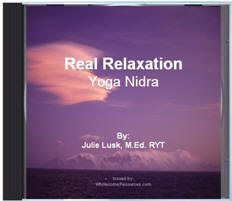
Real Relaxation Yoga Nidra takes you into a deeply relaxing and powerful restful state of being fully aware while being in the state of deep yogic sleep. It helps with balancing chakra energy, and can improve immunity, heart health, relieve stress and give you inner peace and balance.
Get it from Amazon, iTunes, Spotify & other online stores
Chakra Balancing with Toning and Hand Mudras
Chakras, Mudras, and Sound Healing
Learn an Elemental and Chakra Meditation with
Hand movements, Color, Sound, and Intention
The major chakras are spinning wheels of energy that span from the base of the spine to the crown of the head. They guide the wellbeing of our bodymind and LifeForce energy.
Chakra energy can be balanced, excessive, or deficient. Being out of balance can negatively influence your actions, relationships, as well as your physical, mental, and emotional health. Use my Chakra Chart to determine if your energy is in balance or not. You’ll get a variety of helpful strategies to improve your wellbeing.
Yoga Mudras are yoga positions, gestures, and seals for your hands and fingers that facilitate health, healing, psychological balance and spiritual transformation. They are effective, easy to learn, practical and powerful. Mudras can be a powerful and effective way to help gain balance and have better health by either increasing or decreasing chakra energy.
Sound healing can also be used for chakra balancing.
Elemental & Chakra Meditation with
Hand Movements, Color, Sound, and Intention

See how the fingers and the thumb are associated with specific chakras and their associated sounds with this color-coded hand diagram.
Bija sounds encode the 5 elements into sound and increase and attract energy. They are lam, vam, ram, yam, ham, Om, and silence. They are pronounced with a ‘U’ sound and rhyme with hum. Vowel sounds decrease and disperse energy.
Experiment & Discover | Hum. Play a variety of sounds, tones, notes, and musical instruments. Use your intuition. Tune in and trust your direct experience by listening and noticing your physical and energetic response.
Mudra Hand Meditation | Tone & touch the thumb to each fingertip on both hands. Try starting on the ring finger (4th finger) for the first chakra. The index and thumb are used for both the 3rd and 4th chakras. Join fingertips and thumb for OM. Reopen hand for silence. Alternatively, try starting with the OM and descend from the crown chakra to the root using the associated finger and sounds.
Tuning Fork Meditation | Listen to unweighted tuning forks associated with the chakra notes. Touch a weighted OM fork to fingertips and center of palm on both hands. Treat both hands.
OM | Find out about the purpose, meaning, symbolism, and benefits of OM.
Chakra Tone Chart and Hand Diagram 2022 | Compiled by Julie Lusk |References | JulieLusk.com Yoga Nidra for Complete Relaxation & Stress Relief & other books by Julie Lusk | How to Heal with Singing Bowls by Suren Shrestha* | Sreedevi Bringi | Tony Nec
- Learn about chakras and their influences | Get your Complete Chakra Chart
- Chakra Balancing with Sound Healing. Use the Elemental Chakra Tone Chart to balance your chakra energy by either increasing or decreasing their energy with sound, color, and special mantras. The Vedic (Yoga) and Tibetan notes and tones are given. It’s fun.
- How to balance chakra energy with toning and hand & finger movements called mudras.
- Get info related to chakra elements, directions, sounds, senses, and other attributes
- Chakra Energy Flow Meditation
- Understanding OM | AUM
- Book a Musical Sound Bath session
Awaken joy, peace and inspiration with this yoga meditations book.
Yoga Meditations contains a wide variety of mind-body practices, such as:
* Guided relaxation exercises
* Breathing practices
* Yoga Nidra
* Meditations and guided imagery
* Affirmations
* Yoga postures and meditations for each chakra
* Yoga wisdom for contemplation
Get a FREE Wholesome Energizers CD in every book!
CLICK the blue title link above to find out more...
Finally! A complete Chakra Chart with all the chakra names, locations, colors, sounds, yoga postures, breathing techniques, psychological & energetic influences and more. There's handy tips for using the chart on the reverse side. It's 8 1/2 by 14" and laminated. CLICK on the blue title link above to find out more...
Chakra-Based Guided Meditations
Real Relaxation Yoga Nidra takes you into a deeply relaxing and powerful restful state of being fully aware while being in the state of deep yogic sleep. It helps with balancing chakra energy, and can improve immunity, heart health, relieve stress and give you inner peace and balance.
Get it from Amazon, iTunes, Spotify & other online stores
Sleep Solutions – Yoga Style
How’s Your Sleep?
Are you getting enough sleep? Are you tired of being tired? Could you be suffering from sleep deprivation? Well, you’re not alone. Most of us don’t get enough sleep. I don’t know about you, but it’s just irresistible to stay up late, even when I must get up early the next day.
Our busy lives make it so tempting to skimp on sleep. Lots of us have trouble falling asleep or staying asleep. Have you ever felt half-awake and half-asleep all night, here’s an explanation of why that happens with suggestions to help.
The American Academy of Sleep Medicine recommends 7 hours of sleep in every 24 hours for adults. It’s nine to 12 hours for children 6 to 12 years old and teens need eight to 10 hours daily on a regular basis. Establishing good sleep hygiene habits are important to getting a full night’s sleep.
Benefits of Sleep
Getting enough sleep helps normalize mood, improves concentration, memory consolidation, and helps pain management. It improves performance and lowers the risk of having an accident. Sleep is good for your skin and your sex drive. It lowers cortisol, the stress hormone, resulting in better appetite control and weight loss. Getting enough sleep helps regulate glucose levels, supports heart-health and contributes to a healthy immunity. Recent NIH research reveals that sleep is needed to remove the daily buildup of waste and neurotoxins from the brain. Researchers are very interested in this since these neurotoxins are elevated in Alzheimer’s patients. It is thought that the glymphatic system rinses and flushes these neurotoxic molecules from the brain nightly during deep sleep. This clearing process seems to be more effective when sleeping on one’s side, according to a study conducted at the University of Rochester Medical Center. Here’s more information on side-sleeping.
Sleep Solutions – Yoga Style
The art and science of yoga has plenty to offer including postures, breathing techniques, meditation practices, and lifestyle recommendations for sleep improvement. To further ease one’s mind, yoga’s wisdom teachings are helpful for gaining a healthy perspective on everything from handling life’s ups and downs to living with more meaning and purpose. Furthermore, it addresses age-old questions like “Who am I?” and “What is my true nature?”
Students often say that they get their best sleep on the nights they attend yoga class. Having a regular personal home practice is ideal. Here are some of the many ways that yoga supports healthy sleep.
- Yoga Postures: A vigorous practice is fine early in the day. However, start winding down the evening with a practice that focuses on slow, mindful movements. Focus your attention on postures that reduce physical tension. Doing so has the added benefit of calming the mind and emotions. Good ones to try include the child pose, gentle spinal twists, legs up the wall, and shavasana. Restorative yoga works wonders as well.
- Yoga Breathing: The Triangle Breath is a favorite for balancing oneself and is described in my book, Yoga Nidra for Complete Relaxation and Stress Relief (NHP, pg. 175). It is effective for increasing your energy when feeling tired, calming your nerves when feeling anxious, and promotes sound sleep. There are three parts to triangle breathing. The important thing is for the exhalation, inhalation, and the retention to be equal in duration. Therefore, adjust the rate of counting to four more quickly or more slowly depending on your lung capacity and comfort. Breathe through your nose; only use your mouth for breathing to the extent necessary.
Part 1 – Breathe out through your nose to the count of four.
Part 2 – Breathe in through your nose to the count of four.
Part 3 – Hold your breath to the count of four.
Repeat the whole process for a few minutes or until the desired effect happens.
- Yoga Nidra: Yoga nidra means “yogic sleep” and has many documented benefits for your body, mind, and spirit. It happens when your bodymind is in deep sleep but with one big difference – you remain consciously aware. How? A series of techniques are used systematically to relax physically, energetically, mentally, and emotionally. Yoga nidra awakens intuition, unconditional joy, and a timeless, spacious sense of being. Get more on the stages of yoga nidra and how to practice it here.
Yoga nidra can also be used as a natural sleep aid at bedtime. It eliminates layer after layer of tension and stress, allowing you to drift comfortably off to sleep and stay asleep. It’s like drinking a cup of comfort. More on this here.
Watch this short video on how yoga nidra helped her insomnia.
One hour of yoga nidra practice approximates four hours of sleep. This is due to the series of brain wave states experienced during yoga nidra (Saraswati 1998, Kumar 2008). Therefore, yoga nidra can help address sleep deprivation and renew your energy. The conscious experience of deep sleep is what makes it so restorative and unique. Due to the fertile brainwave states experienced, it’s also entirely possible to make positive behavior and personality changes. See the yoga nidra FAQ on setting intentions and sankalpas here. Remember, yoga nidra is not intended to be a substitute for sleep.
How to Experience Yoga Nidra:
Like all worthwhile things, regular practice yields the best results. It’s as easy as 1-2-3.
- Listen to Yoga Nidra Meditations: 24 Scripts for True Relaxation | Audible – iTunes – Amazon
- Read about it and get free audio downloads in Yoga Nidra for Complete Relaxation and Stress Relief (New Harbinger, 2015).
- Experience yoga nidra on video/audio.
- Attend a virtual yoga nidra class held weekly on Zoom.
- Take a yoga nidra teacher training course and earn a certificate.
- Get yoga nidra downloads here.
- Get a book or audio below.
Sweet Dreams!
 Sleep Well | Yoga Nidra CD Use deep relaxation, soothing flute music & ocean waves to go to sleep. "I slept like a log." Downloads available. By Julie Lusk, Yoga Nidra Meditations author.

Julie Lusk, MEd, E-RYT 500, has more than 35 years of expertise in stress relief, yoga, relaxation training, guided imagery, and meditation as an international author, recording artist, and workshop leader. Julie is the author of Yoga Nidra for Complete Relaxation and Stress Relief, Yoga Meditations, two volumes of 30 Scripts for Relaxation, Imagery and Inner Healing, and Desktop Yoga®. Her audio downoads and CDs include Wholesome Relaxation, Power of Presence, Blue Moon Rising, and many others. Learn more at WholesomeResources.com
