Mindfulness Meditation Warnings & Alerts
Julie Lusk, M.Ed., NBCC, E-RYT-500
Wholesome Resources for Mind-Body Mastery through Yoga, Meditation, Guided Imagery, Stress Relief, Wellness


How to Balance & Tune
Chakra Energy
Using Healing Sound Vibrations
Page Summary | Chakra Energy | Sound Healing | Chakra Tone Chart
Chakra Energy
Chakras are spinning wheels of subtle energy. The major chakras span from the base of the spine to the crown of the head. They guide the wellbeing of our bodymind and lifeforce energy. You can learn more about chakras and their influences here. Get info related to chakra elements, directions, sounds, senses, and other attributes here.
Chakra energy is often out of balance. It can run too high or too low. This can negatively influence your actions, relationships, as well as your physical, mental, and emotional health.
Use my Chakra Chart to help you in knowing if your energy is balanced, excessive, or deficient. A variety of helpful strategies are given to improve your wellbeing.
There is a lot you can do to gain balance and have better health by either increasing or decreasing chakra energy. This can be supported through intentionally using sound, color, crystals, and mantra. Yoga postures and pranayama (breathwork) influence the chakras. Healthy lifestyle choices make a difference. Meditation, guided relaxation and imagery are very effective. Using hand and finger positions called Yoga Mudras are also powerful.
Sound Healing
Sound healing intentionally uses musical instruments and vocals to help with harmonizing the body, mind, emotions, and spirit into wholeness. A positive impact on wellbeing happens when these dimensions are tuned and in balance.
Sensing calmness, connections, mental clarity, emotional equilibrium, insightful awareness, and balanced energy often happen.
A variety of instruments can be used including Tibetan and crystal bowls, tuning forks, drums, bells, flutes, gongs, chimes, strings, and keyboards. Vocal singing and toning are powerful as well.
The tones, frequencies, and vibrations used in sound healing are experienced both physically and energetically. Obviously, sounds are heard with the ears. Not so obviously, they are experienced and absorbed through the skin, by the cells, and in the energy field.
Sound healing facilitates vibrant health by activating the relaxation response, synchronizing and activating brainwave frequencies beneficially, and supporting heart coherence. It has been shown to regulate the nervous system. Chakra energy is often toned and harmonized. Chakra disharmony is discussed below.
Sound healing is based on age-old teachings and backed up by modern science. It’s interesting, relaxing, and fun.
Chakra Tone Chart

This Chakra Tone Chart can help balance your chakra energy to improve your wellbeing. These sound vibrations are based on ancient Vedic (Yoga) and Tibetan notes and tones, and western music.
Use this Chakra Chart to help you know if your energy is balanced, excessive, or deficient. It gives you a variety of helpful strategies to improve your wellbeing.
Try all the healing sound vibrations to find out what you like and works best for you. Notice your felt reaction to each of these scales, notes, and sounds to determine how your bodymind responds to each vibration.
Handy Links


Chakra-Based Guided Meditations
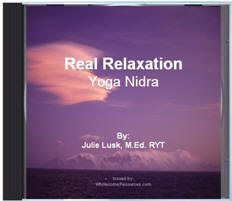
Real Relaxation Yoga Nidra takes you into a deeply relaxing and powerful restful state of being fully aware while being in the state of deep yogic sleep. It helps with balancing chakra energy, and can improve immunity, heart health, relieve stress and give you inner peace and balance.
Get it from Amazon, iTunes, Spotify & other online stores

What a pleasure to specialize in balancing and strengthening the body-mind-spirit connection through yoga, meditation, positive relaxation, and guided imagery. I feel so fortunate to have discovered yoga and meditation as a young woman in the 1970’s and to continue to study and practice till now. What a joy it has been to teach all these years and to be the author of the many books and recordings listed below on yoga nidra, meditation, guided imagery and similar practices.
My professional counseling training, certification, and work has been invaluable, providing me with an enriching perspective on mind-body interventions. Professionally, I have been a regional director for a large hospital-based holistic health and wellness program, director of health management and wellness at a well-known medical clinic, an assistant dean of students for career planning and placement at a college, director of special services at a community college, and an educational awareness counselor. Thousands have been touched through my volunteer work.
Most of all, I love sharing all this with others. This has given me a practical sensibility of what works and what doesn’t as well as all the benefits that happen. It’s a real joy for me to teach others as a teacher and trainer.
Graciously,
Julie Lusk, M.Ed., E-RYT-500


 White Lotus Foundation – Advanced Teacher Training, 1996
 M. 1995; Bill O’Hanlon,


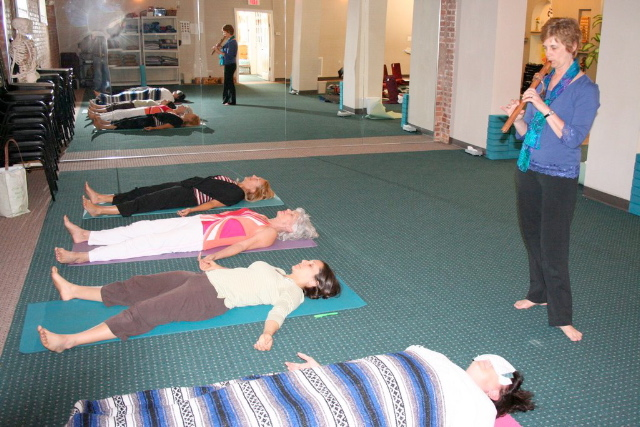

Have you ever felt like you were ‘half-awake or only half asleep’ all night? Me too. It’s so frustrating, especially knowing that you have a big day ahead and want to be feel sharp and well rested. Perhaps you don’t want to miss a moment of your vacation or there’s an important conference you’re excited about.
 As it turns out, half of your brain can sleep while the other half stays awake, according to sleep scientist Masako Tamaki and her colleagues at Brown University and reported in Current Biology*. They found that this usually happens when sleeping the first night in a new place, like a hotel, friend’s house, or while camping. The second night is much better.
It’s our brain’s attempt to protect us by going into survival mode. What happens is that the right half your brain sleeps while the left half stays alert, standing guard. How strange is that?
Scientists measured the slow-wave activity of the brain, something that occurs during deep sleep. They measured brain activity during light sleep by first playing a tone and then a different tone was played. Surprisingly, the brain reacted to the variation in sound only on the left side of the brain – the right side stayed asleep.
Next, they played a sound loud enough to awaken someone. They found that when it was transmitted into the right ear, the subjects in the experiment woke up faster than if it was sent to the left ear. The right ear is associated with the left side of the brain.
It stands to reason that it would be the left side of the brain that stays on duty since it is known to be objective, analytical, and rational and would be more prone to be protective whereas the right side is best at intuition and abstract thinking. Could this phenomenon be at play when sleeping in an unsafe neighborhood or household? What about when having to keep an ear out for a child or sick person. More studies are needed.
Sleeping ‘half-way’ is involuntary and the brain’s way to keep you alert enough to save yourself if something bad happened and most likely associated with the flight-fight-freeze response to stress. Because of this, scientists think there’s not much you can do about it other than to accept it rather than letting it bother you. Some suggest going two nights ahead of your big day since it’s so hard to sleep that first night.
Here are my suggestions:
So even if you can’t sleep as soundly as you might like due to your brain’s insistence on staying half-awake, at least you now understand the reason why. The above suggestions may lull you to sleep, and if they don’t, you will at least make use of the time in a positive, productive way.
Sweet dreams!
 Sleep Well | Yoga Nidra CD Use deep relaxation, soothing flute music & ocean waves to go to sleep. "I slept like a log." Downloads available. By Julie Lusk, Yoga Nidra Meditations author.
Reference: Current Biology Volume 26, Issue 9, p1190–1194, 9 May 2016
Resources: Yoga Nidra for Complete Relaxation & Stress Relief by Julie Lusk (NHP 2015)
Yoga Nidra: Guided Meditations for Relaxation & Renewal (Health Journeys 2016)
Julie Lusk, MEd, E-RYT 500, has more than 35 years of expertise in stress relief, yoga, relaxation training, guided imagery, and meditation as an international author, recording artist, and  workshop leader. Julie is the author of Yoga Nidra for Complete Relaxation and Stress Relief, Yoga Meditations, two volumes of 30 Scripts for Relaxation, Imagery and Inner Healing, and Desktop Yoga®. Her CDs include Wholesome Relaxation, Power of Presence, Blue Moon Rising, and many others. Learn more at WholesomeResources.com
 Whether you’re celebrating Christmas, St. Nicholas, Kwanza, Winter or Summer Solstice, Navidades, Hanukkah, St. Lucia Day, Boxing Day or New Year’s, the holidays can be stressful.
Decide now whether this year will be full of the season’s stressful traps or fulfilling with plenty of treasures to be thankful for. Take some time to set priorities and make the necessary changes so the holidays are inspiring and energizing instead of a drain. Pay attention to what your needs and wishes are for your body, mind, and heart while finding the balance with sharing with others. I hope these Holiday Energizers from Whole Person Associates help you as much as they help me.
Know what goodies will fill you. What kind of contact will be fulfilling for you? What kind of gift exchange will be meaningful to you? What do you need to help your heart and soul feel refreshed? If you know clearly what you want, it’s easier to choose activities that are likely to satisfy your desires.
Ask for what you want. Don’t hint. Don’t wait for someone to read your mind. Don’t expect others to guess what will satisfy you. Speak up. If you’re lonely, ask someone to share your celebration – or ask to share in someone else’s. If you love surprises, let people know. If you need time alone in the midst of togetherness, say so. If you can’t get what you want, want what you get, it’s much more satisfying than wishing for the impossible.
