Wholesome Resources

Wholesome Resources for Mind-Body Mastery through Yoga, Meditation, Guided Imagery, Stress Relief, Wellness

View Cart
Facebook
Facebook
fb-share-icon
Post on X
YouTube
LinkedIn
LinkedIn
Share
  • Home
  • About
    • About Wholesome Resources
    • About Julie Lusk
    • Education, Training, Publications & Experience
    • Testimonials
    • In the News
    • Tapin Family History
  • Class Offerings
    • Complete Course List
    • Online Yoga Classes
      • Online Yoga Nidra Class
      • Online Yoga Postures, Mindfulness & More Class
    • Yoga on Demand
    • Class Downloads
    • SoulCollage® Online Workshops & Supplies
      • SoulCollage® Supplies
    • Special Workshops | Trainings | Retreats
    • Yoga Nidra Teacher Training
    • Personal Lessons – Speaking – Training – Coaching
      • Private Lessons, Consults, Coaching
      • Yoga Meditation Retreats, Teacher Trainings
      • Business, Organization, Conference Speaker
    • Testimonials
  • Shop | Books + Audio
    • Complete Catalog
    • Books in Print & eBooks
    • Audio Streams & Downloads
    • CD’s
    • Special Savings
  • Cart
  • Library
    • Yoga
    • Yoga Nidra
      • Yoga Nidra FAQ: Real Relaxation, Meditation & Much More
      • Practice Yoga Nidra
        • Experience Yoga Nidra .. Free Video/Audio & Class Schedule
        • Yoga Nidra Meditations: 24 Scripts for True Relaxation .. Book, Audio, eBook
        • Yoga Nidra for Complete Relaxation & Stress Relief .. Book, eBook
      • Yoga Nidra Benefits
      • Yoga Nidra FAQ on Setting Intentions & Sankalpas
      • Savasana: Yoga’s Relaxation Pose
      • Yoga Nidra and Sleep
      • Yoga Nidra Teacher Training
        • Certified Yoga Nidra Teachers
        • Ethical Matters for Yoga Nidra Professional Training Course
    • Meditation | Guided Imagery
    • Chakra Energy
      • Complete Chakra Chart
      • Chakra Balancing with Sound Healing
      • Chakra Balancing with Hand Mudras & Toning
      • Chakra Chart of Elements, Sounds, Directions, Senses, Attributes & Koshas
      • Chakra Energy Flow Meditation
    • Mind Body Helpers
      • Helpful Mind-Body Articles | Blog
      • Mind Body Connections
      • Wellness
      • Stress Relief
    • Quotes | Mantras | Chants
      • Yoga Sayings. Quotes. Poems
      • Best Yoga Mantras & Chants
      • Links
    • Yoga Pets
  • Flutes | Sound Baths
    • MusicSmith Flutes Info
    • Store | Native American Style Flute
    • Flute Music | Scales | Embellishments | Lessons
    • Playing Tips | Flute Care | Troubleshooting | Native American Style Flutes
    • Musical Sound Bath Tune Up
    • Music Lessons
  • Contact
    • Disclaimer / Terms of Service
You are here: Home / Search for "core/• https:/wholesomeresources.com/chakra-energy-flow-meditation/details-wholesome-energizers-cd/details-yoga-meditations-book-and-cd-set/about-julie-lusk/details-real-relaxation-cd"

Search Results for: core/• https:/wholesomeresources.com/chakra-energy-flow-meditation/details-wholesome-energizers-cd/details-yoga-meditations-book-and-cd-set/about-julie-lusk/details-real-relaxation-cd

What is Meditation?

March 28, 2014 by Julie Lusk

Let’s define meditation. While guided imagery allows thoughts and feelings to occur while directing and focusing the Buddhamind in certain areas, meditation seeks to bring about a state of awareness without thinking.  This is not be to confused with attempting the impossible task of clearing and emptying the mind completely, rather, it is about becoming conscious and aware of our thoughts, feelings, physical distractions, and the other senses.  This awareness helps us cultivate acceptance, compassion and wisdom.  This is the wisdom of self understanding so an appropriate response is revealed.  The goal of meditation includes remembering and experiencing the connection between oneself and the divine.

While there are hundreds of meditation techniques, the basic elements include sitting in an upright manner with a straight, but not stiff, spine.  Taking time to bring the breath into balance and focus, and using a concentration technique are often incorporated.  Concentration calms and clears the mind of distraction making room for the meditative state.

Here are a few fundamental meditation methods.  A mantra, which is a word, sound or phrase can be silently repeated over and again; focusing attention on the sensation of the breath can be used; being mindful of the present moment is another practice; and gazing upon an object, such as a candle flame, nature scenes, or holy picture is another approach.
Filed Under: Meditation / Guided Imagery Tagged With: define meditation, what is meditation

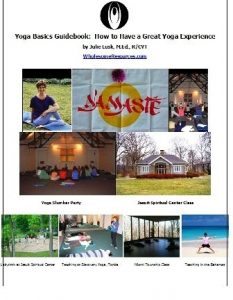
Details Yoga Basics Guidebook

Yoga Guidebook: How to Have a Great Yoga Experience

by Julie Lusk, M.Ed., C/RYT -E500

Yoga Guidebook - Instant PDF Download!
Yoga is the perfect way to * Tone your body and improve health * Clear your mind and calm emotions * Change negative stress into positive energy and * Make new friends. This handy download gives you all the essential resources and guidelines you need for a great start.
Quantity:  
Price: $5.00

Yoga is the perfect way to


  • Tone your body and improve health
  • Clear your mind and calm emotions
  • Change negative stress into positive energy
  • Make new friends

This handy download gives you all the essential resources and guidelines you need for a great start.

This eBook highlights:

  • Essential information to help you know what to do to maximize your experience
  • Guidelines for health conditions with tips for people with arthritis, back problems
    cancer, high blood pressure, and women’s health (menstruation, PMS, menopause)
  • List of benefits, cautions, and contraindications for yoga postures
  • Handy yoga glossary, drawings of yoga postures, warm-ups, and lesson plans
  • How to start and maintain a yoga practice for yourself
Yoga Guidebook - Instant PDF Download!
Yoga is the perfect way to * Tone your body and improve health * Clear your mind and calm emotions * Change negative stress into positive energy and * Make new friends. This handy download gives you all the essential resources and guidelines you need for a great start.
Quantity:  
Price: $5.00

Playing Tips | Flute Care | Troubleshooting | Native American Style Flutes

MusicSmith Flutes | A Native American Style Flute | Handmade by Dave Lusk

Native American flutes were first created and played by Native American people. They are instruments of beauty, magic, ceremony, healing, and entertainment. They bring out the music that dwells in all of us.

This instrument has a full, warm sound. Made from western red cedar, it’s protected with non-toxic waterproofing, inside and out. Each flute is embellished with a unique design handcrafted with a wood-burner. A thumb-rest is offered. This innovation stabilizes and balances the flute while playing by positioning your lower hand correctly. Place the thumb of the lower hand against the bottom of the thumb-rest. The index finger covers the hole right above.


Playing your Flute |There are no wrong notes! All notes harmonize melodically. Reading music is not needed.

  • Press your lips against the mouthpiece to gently seal it.
  • Cover the holes with the finger pads, not the tips or nails.
  • Adjust the air pressure until notes sound clear.
  • The note played with all the holes closed is the key of the flute.  It’s called the flute’s fundamental note.
  • Use the fingerings shown below. Cover and uncover the holes one at a time in order.
  • The third hole down on a 6-hole flute always stays covered to play the minor pentatonic scale and uses all the notes shown on the chart.
  • For a major scale, start and land on the second note up from the bottom of the flute.
  • Start going up and down the flute, slowly and evenly. Gradually pick up speed. Next, vary the rhythm. Play melodies by playing the basic scale but put intervals between the notes. For example, cover all the holes followed by another finger pattern. Doing so will always sound melodic and harmonic.
  • Embellishments and more scales can be added for more musicality once you’re proficient.
  • Have fun!

Tip: The third hole down always stays covered in the minor pentatonic scale and uses all the notes shown on the chart. For a major scale, start and land on the second note up from the bottom of the flute. Once proficient, embellishments and more scales can be added.

Basic Fingering Chart


Caring for your Flute | Keep your flute at a steady temperature. Do not let it get too hot or cold. Temperature variations expand and contract wood. This can cause your flute to crack. If the flute is cold, warm it with your hands and gently blow warm air into it. Do not leave it in a car when it’s either hot or cold. Avoid direct sunlight.

Remove the block after playing to dry the flute out. Wipe off any moisture. To retie the block, position the front edge of the block at the back edge of the sound hole. Tie tightly. Experiment with its placement for the best tone. Push it slightly forward to raise the pitch higher (sharp), move it back to lower it (flat).

Caring for Yourself  with Hand Warm-ups | Here’s an easy 5-minute series of hand movements & mudras to help your fingers, wrists & hands with easy-to-remember names for each one. Great for musicians & anyone with stiff, painful fingers, hands or wrists. Learn the Hakini Mudra, Beak, Bug, Claw, Paw, Seed, Web, Wings, and the Eagle & Hridaya mudras. Thank you Christine Stevens at Upbeat Drum Circles for interviewing me.


Troubleshooting | Fuzzy, unclear, sour, airy, or shrillness

  • Cover the holes completely or else it will squeak or sound airy.
  • Adjust air pressure. Are you blowing too softly or too much?
  • Make sure the block is tied down tightly (see above).
  • Poor tone quality occurs when moisture collects inside the flute, especially between the mouthpiece and the block. To remove it, hold the flute tightly and briskly shake the whole flute. Try covering the sound hole with a finger and blow hard to push the moisture out. Release your finger while still blowing. Wipe off.
  • The bottom note is the hardest to play. It’s important to make sure all the holes are completely covered. Use a mirror. This note will jump an octave if too much air is used.

MusicSmith Flutes info, tips, etc. (pdf to download/print)


Music Lessons |  Music lesson details and registration


Handy Links

  • MusicSmith Flutes Info 
  • Store| Native American style wood flutes for sale
  • Playing tips, flute care, troubleshooting
  • Flute Music | Scales | Embellishments | Lessons
  • Musical Sound Bath Tune Up
  • Music lesson details and registration
  • Contact us anytime.


Contact us anytime about flutes & lessons.

By appointment only ♥ Not a retail store.


How to Make a Yogatini

July 10, 2017 by Julie Lusk

How to make a Yogatini ~ Inspired by Tracey Rich
Ingredients:
  • Yoga mat
  • Fresh air
  • Music
  • You
Mix: 
  • 1 part Ocean sounding breath – also called ujjayi breath
  • 1 part Salutation to the Sun – See video here
  • Practice barefoot in the grass or on a sandy beach for some great grounding time. Here’s more about it.
  • Stir in your own music, flow, fun, and friends.
  • Cool down with Shitali Breathing
  • Finish with some floating yoga nidra bliss.
  • Have a beautiful summer and come Yoga with us!
Benefits:
  • Calorie Free
  • Gluten Free
  • Feelings of freedom, happiness, and joy!
Click now for more Meditation, Relaxation, Guided Imagery Techniques & Articles

Filed Under: Mind-Body Mastery Tools and Techniques, Relaxation Exercises, Stress Relief / Management

Ocean Sounding Breath: Ujjayi Breathing

March 28, 2014 by Julie Lusk

Ujjayi is pronounced oo-JAH-yee or sometimes “ooo” as in cool and “ji” as in hi
Time: 5 minutes or longer

Summary: The Ujjayi Breath, also called the Ocean Sounding Breath, is a yogic breathing practice that builds on the Hilton Head oceanbenefits of Dirgha Breathing, the complete breath. Meditative and calming, it creates concentration while it creates stamina and endurance. It produces a calming and meditative quality. This breath helps relieve sinus problems and can diminish headache pain.

The Ujjayi is performed by taking long, slow and deep breaths (the complete dirgha pranayama) while creating a special sound in the back of the throat that sounds like the ocean waves. Although you will breathe in and out through your nose when doing Ujjayi, it is easier to learn first by breathing through an open mouth while whispering the sound of “home” or “Om.” Doing so will allow you to experience the open feeling in your throat that is used in Ujjayi breathing. When practicing, notice how your lips are slightly open when whispering the “ho” or “o” sound. Also notice the open feeling in your throat. Maintain the open sensation in your throat as the sound changes into “mmm.”

Listen to the sound at the back of your throat as you continue breathing out. Repeat several times drawing out the “mmm” sound more and more each time. This is the Ujjayi sound, a unique, audible Darth Vader-type sound. This same sound and feeling in your throat is used for the inhalation as well.

Next, close your mouth and continue breathing in and out through your nostrils while maintaining that feeling and sound in your throat. When done correctly, there is a slight constriction in the glottis (the opening between the vocal chords) during inhalation and exhalation. Once mastered and the breath is refined, the sound is made by fully relaxing the same area of the throat.

Let’s begin. Either come into a comfortable seated position with your spine erect or lie on your back. Begin by taking long, slow and deep breaths through the nostrils. Allow the breath to be gentle and relaxed as you slightly activatet the back of your throat creating a steady ocean sound as you breathe in and out. The sound need not be forced but it should be loud enough so that if someone came close to you they would hear it.

Gradually, lengthen the inhalation and the exhalation as much as possible without creating tension anywhere in your body, and allow the sound of the breath to be continuous and smooth. Keep the pitch and intensity of the breath consistent and even throughout. Practice breathing so both your inhalation and exhalation are equal in length and duration.

Continue practicing, allowing your inhalations and exhalations to follow a circular flow that is continuous and almost seamless, leaving as little space between the incoming and outgoing breath as possible.

Remember to relax into your breathing; there is no reason to rush. Another breathing pattern to practice after your Ujjayi breath becomes smooth and seamless is to hold the breath for a few seconds at the end of the inhalation and/or at the end of the exhalation. This tends to produce more focus. However, never hold your breath if you have high blood pressure.

Filed Under: Misc Musings, Stress Relief / Management, Yoga, Yoga breathing technique

  • « Previous Page
  • 1
  • …
  • 26
  • 27
  • 28
  • 29
  • 30
  • …
  • 35
  • Next Page »

Share | Follow

Facebook
Facebook
fb-share-icon
Post on X
YouTube
LinkedIn
LinkedIn
Share

Donate to support my website & our dog Breezy … Click her pic. Thanks!

Recent Posts

  • Happy Humming Practice
  • 12 Symptoms of Inner Peace
  • Emotional First Aid Kit | Personal Worksheet
  • Insomnia? Welcome to the 4 am Club
  • Get-a-Dose of MindBody Bliss

Find Articles by Topic

News Flash

Click here for my latest book & free audio download of the 3 main yoga nidra exercises! It's as relaxing as it is … [Read More...]

Julie T. Lusk, M.Ed.

Wholesome Resources

Milford, OH 45150

Greater Cincinnati Area

513-248-YOGA (9642)

Donate to support my website & our dog Breezy … Click her pic. Thanks!

Join Our Network

Join Our Network

Free Newsletter Signup

Privacy Policy & Use of Cookies

Site content Copyright © 2005-2026 – Wholesome Resources – All Rights Reserved
Site administration by The Small Business Website Guy