Mindfulness Meditation Warnings & Alerts
Julie Lusk, M.Ed., NBCC, E-RYT-500
Wholesome Resources for Mind-Body Mastery through Yoga, Meditation, Guided Imagery, Stress Relief, Wellness


Dirgha is pronounced DEAR-gah
Summary: This breathing technique is done with long, slow, deep breaths while focusing on the lower, mid, and upper portions of your chest. This allows for the fullest breathing possible and will improve respiration, circulation, and even digestion. The complete breath will soothe your frazzled nerves, clear your mind, and will replenish your life force.
Controlling the volume, duration and frequency of the inhalation, the exhalation, and the pauses between each breath enhances prana, the energy that supports and sustains the life force. Breathing becomes slow and refined.
~~Yoga Sutra 2.50
How to practice the complete yogic breath / dirgha breathing
Either come into a comfortable seated position with your spine erect or lie on your back. It is easier to learn this while lying on your back.
Breathing through your nose is optimal because it [Read more…]
 Yoga nidra’s benefits are remarkable. Yoga nidra means “yogic sleep.” It’s a comprehensive meditative practice for going far beyond deep relaxation to a place of natural peace and quiet that is tremendously healing for the body, mind, and spirit. Unique skills are developed for handling stress and tension in the short term and for the long run. Yoga nidra feels extremely peaceful and is very refreshing. It’s based on classical yoga and backed by contemporary science.
Here are some of yoga nidra’s benefits from Yoga Nidra for Complete Relaxation & Stress Relief by Julie Lusk, pgs. 42-43, NHP 2015):
Experience yoga nidra’s benefits for yourself. Like most worthwhile things, regular practice yields the best results. This book and audio set is everything you need to get started and will support your practice for years to come.
 Experience peace and deeply restorative rest that heals your body, mind & spirit. Features 24 Yoga Nidra scripts written by author Julie Lusk and 12 of the world's master teachers. Enjoy 6 levels of relaxation for a joyful meditative experience. Learn to use yogic sleep to revitalize your inner reservoir of intuitive understanding and unconditional joy. Audiobook available.
CLICK the blue title link above to find out more...
Experience peace and deeply restorative rest that heals your body, mind & spirit. Features 24 Yoga Nidra scripts written by author Julie Lusk and 12 of the world's master teachers. Enjoy 6 levels of relaxation for a joyful meditative experience. Learn to use yogic sleep to revitalize your inner reservoir of intuitive understanding and unconditional joy. Audiobook available.
CLICK the blue title link above to find out more...
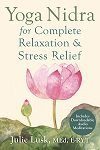 Yoga Nidra can stop tension in its tracks with a wonderfully, powerful & unique state of deep relaxation, mental clarity & insightful awareness.
These practical, empowering relaxation exercises, meditations that soothe and visualizations that renew are based on classic yoga and backed by modern science. They’ll help you unwind, replenish, and feel refreshed with durable peace and unconditional joy.
CLICK the blue title link above to find out more...
Yoga Nidra can stop tension in its tracks with a wonderfully, powerful & unique state of deep relaxation, mental clarity & insightful awareness.
These practical, empowering relaxation exercises, meditations that soothe and visualizations that renew are based on classic yoga and backed by modern science. They’ll help you unwind, replenish, and feel refreshed with durable peace and unconditional joy.
CLICK the blue title link above to find out more...
Yoga Nidra Essentials CD Find your calm spot. Brighten your energy. Enjoy a more meaningful life. Experience 6 levels of relaxation. Reclaim optimal health for your body, mind & heart. Laura says "My focused mind easily. I was 100% worry-free. It's wonderful." By Julie Lusk, 6-time author. Digital downloads available.
References:
Amita, S. et al. 2009. Effect of Yoga Nidra on Blood glucose Level in Diabetic Patients. Indian Journal of Physiological and Pharmacol, Vol. 53 (1): 97-101.
Kumar, Kamakhya. 2013. A Handbook of Yoga Nidra. New Delhi, India: D.K. Printworld
_____ 2007. The Healing Sleep; Yoga Magazine (Body Mind Spirit); Published from York Street, London; Issue 50
Lusk. 2015. Yoga Nidra for Complete Relaxation & Stress Relief. Oakland: New Harbinger
Panda, Nursingh Charan. 2003. Yoga-Nidra: Yogic Trance Theory, Practice and Applications. New Delhi, India: D.K. Printworld (P) Ltd.
Adapted from Julie T. Lusk’s Book
 Just like your computer needs a screen saver, your body needs a body-saver. Here is a well-rounded set of yoga-based exercises that can be done right from your chair at work, home, or in your car. They’re perfect for “Internet addicts, office workers, and stressed out students.” Julie’s Desktop Yoga ® book contains over 100 easy-to-follow stretches to help your back, neck, shoulders, face, hands and feet; breathing techniques to increase your concentration, improve your sense of inner balance, and aid your circulation; power napping exercises to improve energy by “taking a 2 hour nap in 2 minutes” and proven wellness and stress management strategies that work.
Three Part Breathing: Breathing deeply and fully is essential to yoga. It will help you relax and replenish your energy. Begin by releasing all the air from your lungs through your nose. Use your abdominal muscles to squeeze all the air out. Slowly and smoothly breathe in through your nose so you can feel your belly filling followed by an expansion around your entire rib cage (front, back and sides). Finally allow the air to fill the collarbone area. Release all the air slowly through your nose as you empty your lungs as completely as possible. Continue Three Part Breathing for as long as you comfortably can.
Neck Stretch. Sit up straight and allow your shoulders to relax. Let your right ear move toward your right shoulder. Only move it as far as it comfortably can without force. Take a few full breaths. Just as your muscles begin to tire, take a breath in and bring your head back up to the center.
Next, let your left ear slowly move toward your left shoulder and take a few more breaths. Then, bring your head back to center on an in-breath. It is common for one side to feel more limber that the other side.
Moving your head from side to side can be repeated several times. While doing this, imagine all the stress and strain that’s held around your neck releasing and letting go.
Next, let your chin glide down to your chest and take a few breaths. Remember to let it go as far as it comfortably can without strain. When ready, bring your head to center.
Do not move your head backward. It puts too much stress on that area of your neck.
Shoulder Shrug: Let your arms relax at your sides. Bring both shoulders up toward your ears while you breathe in through your nose. Breathe out through your mouth as you let your shoulders drop back down. Really let go. It’s fine to repeat this a few more times. This releases frustrations as well as shoulder tension.
Energy Stretch: Place both feet flat on the floor and let your arms hang to your sides. As you breathe in slowly, begin raising your arms straight out in front of you until they are shoulder height. Still breathing in, bring your arms out to both sides and then raise them over your head.
Breathe out as you lower your arms back down to your sides. Continue on for several deep diaphragmatic breaths. The trick here is to raise your arms during the time it takes to take a breath in and to lower your arms during the time it takes to breathe out.
Palming Eye Exercise: Rub your hands rapidly together with your palms and fingers touching.
Keep doing it so that you feel some heat and energy being generated. Next, rest your elbows on your desk. Cup your hands and gently place them over your closed eyes. Let the warmth and darkness soothe your eyes. Take several long and easy breaths as you imagine the tiredness being released with your out-breath, and energy and vitality returning with your in-breath.
Hand Helpers: First make a tight fist and feel the tension. Then, let go and release all the tension and tightness. Repeat.
Stretch your fingers and palms out as much as you can. Take your time to really feel the stretch. Let your hands and fingers relax gently on your lap for several moments.
Hold your arms out in front of you and bend your wrists so your fingers point to the sky. Next, point them toward the earth. Repeat, and don’t forget to breathe.
Cat Stretch: Make sure your chair is pushed away from your desktop so that you can sit on your chair and stretch both arms and hands straight out toward the desk. Place your fingers on the desktop or on your knees.
Next, lower your head as you arch your back up (just like a Halloween cat) while breathing out. On the next in-breath, raise your head and chest up while you curve and stretch your back in the other direction. Don’t strain. Continue up and down, breathing in and out as you go. Rest and relax for a few moments with your arms resting on your lap.
Foot Rolls: Kick your shoes off, stretch your legs out in front of you and begin moving your feet around in a big circle. Let your feet, ankles and calves get in on the act. Are you still breathing? Now circle your feet around in the other direction. Rest.
Next, point your toes forward and then back toward your head. Do this several times in a row. Rest.
Then, lift your legs up and move the balls of your feet from side to side. Stretch your toes and relax all over.
→ Julie Lusk, M.Ed. is available to speak about Desktop Yoga ® and a variety of wellness and mind/body topics at your special event.
Julie Lusk was interviewed for an article in Yoga Journal (Feb. 2006) on Desktop Altars.
“You’re reeling from a stressful conference call when another pile of papers appears on your desk, requiring a late-night work session. It’s the kind of thing that could send you over the edge – but after a few deep breaths you’re feeling calm again. Your stay-cool tool? The desktop altar you’ve made to keep yourself centered.
To collect the items for such an altar in your workspace, Julie Lusk, a yoga teacher in Cincinnati and author of Desktop Yoga: the Anytime, Anywhere Relaxation Program for Office Slaves, Internet Addicts, and Stressed-Out Students, suggests sticking to simple objects that are linked to a specific memory, belief, or goal. That might mean a special shell, stone, photograph, flower, fountain, book, plant, or even a simple saying that inspires you.”
“An altar need not scream “Spiritual!” says Lusk. “What makes your collection an altar is your intention – which can be as simple as your desire to return to the present each time you see it.”
– Yoga Journal – Issue 193 – February 2006 – Toni Klym McLellan
1. What is your definition of a “desktop altar”.
Personalizing an area of your workspace to remind you of your higher values/self in a way that is personally inspirational, meaningful, uplifting and keeps you grounded and centered.
2. How might a desktop altar help people supplement their yoga or meditation practice, even in the midst of a hectic workday?
A desktop altar serves as a reminder to breathe, be mindful, and practice Desktop Yoga ™ stretches.
3. What items would you suggest in creating a desktop altar? Please include space-saving considerations.
Select something that is personally meaningful. Start by stilling yourself and become aware of clues from your inner self for some things that are just right. Suggestions include a special shell, stone, photo/picture, flower, cloth, something to hold, art, fountain, a book, plant (i.e. prayer plant, or a violet to care for), feather, finger labyrinth, or a gift from someone special. A saying or a significant symbol could be used as a screensaver. Under various circumstances, a calendar with inspiring sayings or artwork may be just right.
4. Any tips for how to keep it under the radar of coworkers or bosses, but still give it private significance?
5. What items (if any) should be avoided?
6. Can you give some examples of altars?
→ Julie Lusk, M.Ed. is available to speak about Desktop Yoga ® and a variety of wellness and mind/body topics at your special event.
Check out her books and relaxation CDs now.
Please copy and distribute.
Thank you for NOT changing the information or removing contact information.
Handy Links
 sound, color, and special mantras. The Vedic (Yoga) and Tibetan notes and tones are given. It’s fun.
