


Search Results for: wp-content/details-real-relaxation-cd/details-wholesome-energizers-cd/page/8/writings/yoga/RicardoLuis@icloud.com
Yoga Nidra and Sleep
Who couldn’t use some extra shut-eye? Sleep is vital to our health and sleep experts tell us we need an average of eight hours at a shot.  Even if there’s time for sleep, many of us have trouble getting to sleep or staying asleep. Let’s take a look yoga nidra and sleep. Yoga nidra can help in replenishing ourselves, can be used as a natural sleep aid, and more.
Yoga nidra means “yogic sleep” and has many documented benefits for your body, mind, and spirit. It is when your bodymind is actually in deep sleep but with one big difference – you remain consciously aware. This is done by going through a series of techniques to systematically get physically, energetically, mentally, emotionally relaxed. In addition, yoga nidra sparks intuition, unconditional joy, and a timeless, spacious sense of being. Witness consciousness is experienced and even surpassed. Due to the fertile brainwave states experienced, it’s also entirely possible to make positive behavior and personality changes. See the yoga nidra FAQ on setting intentions and sankalpas here.
In fact, while not a substitute for actual sleep, one hour of yoga nidra practice is equivalent to four hours of sleep. This is due to the series of brain waves experienced along the way. (Saraswati 1998, Kumar 2008) With practice, you’ll eventually be able to enter the delta brainwave state but remain aware. It resembles what it feels like to be on the verge of being awake and asleep. The conscious experience of deep sleep is what makes it so restorative and unique.
Yoga nidra can also be practiced at bedtime as a sleep aid. Layer after layer of stress is cleared out so it doesn’t follow you to bed and disturb sleeping. Using yoga nidra techniques as a sleep aid should not be confused with the yoga nidra experience itself. Be careful or you will find it difficult to practice yoga nidra itself and will fall into deep sleep instead.
Yogic sleep is also a play on words of sorts. It refers to how most of us are walking around “asleep” and unaware of our True Self, the indestructible aspect in each of us that is already peaceful, joyful, wise, soulful, luminous, and loving. Whereas, the yogi is awake to one’s True Self no matter what the state of consciousness – waking, dreaming, deep sleep. Realizing this enables us to recognize the true nature of oneself and reality so we are not swayed by the changeability and unpredictability of thoughts, feelings, beliefs and such. Yoga nidra helps us experience and realize this.
In short, yoga nidra is super sleep!
How to Experience Yoga Nidra
Like all worthwhile things, regular practice yields the best results.
- Listen to Yoga Nidra Meditations: 24 Scripts for True Relaxation | Audible – iTunes – Amazon
- Read about it and get free audio downloads in Yoga Nidra for Complete Relaxation and Stress Relief (New Harbinger, 2015).
- Experience yoga nidra on video/audio.
- Attend a virtual yoga nidra class held weekly on Zoom.
- Take a yoga nidra teacher training course and earn a certificate.
- Get a book or audio below.
Get Related article:
Resources: Books, Recordings & More
Get yoga nidra downloads here.
 Sleep Well | Yoga Nidra CD Use deep relaxation, soothing flute music & ocean waves to go to sleep. "I slept like a log." Downloads available. By Julie Lusk, Yoga Nidra Meditations author.
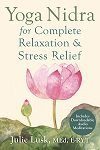
Yoga Nidra can stop tension in its tracks with a wonderfully, powerful & unique state of deep relaxation, mental clarity & insightful awareness.
These practical, empowering relaxation exercises, meditations that soothe and visualizations that renew are based on classic yoga and backed by modern science. They’ll help you unwind, replenish, and feel refreshed with durable peace and unconditional joy.
CLICK the blue title link above to find out more...

Experience peace and deeply restorative rest that heals your body, mind & spirit. Features 24 Yoga Nidra scripts written by author Julie Lusk and 12 of the world's master teachers. Enjoy 6 levels of relaxation for a joyful meditative experience. Learn to use yogic sleep to revitalize your inner reservoir of intuitive understanding and unconditional joy. Audiobook available.
CLICK the blue title link above to find out more...
Yoga Nidra Essentials CD Find your calm spot. Brighten your energy. Enjoy a more meaningful life. Experience 6 levels of relaxation. Reclaim optimal health for your body, mind & heart. Laura says "My focused mind easily. I was 100% worry-free. It's wonderful." By Julie Lusk, 6-time author. Digital downloads available.
Julie Lusk, MEd, E-RYT 500, has over 35 years of expertise in stress relief, yoga, relaxation training,  guided imagery, and meditation as an international author, recording artist, and workshop leader. Julie is the author of Yoga Nidra for Complete Relaxation and Stress Relief, Yoga Meditations, two volumes of 30 Scripts for Relaxation, Imagery and Inner Healing, and Desktop Yoga®. Her CDs include Wholesome Relaxation, Power of Presence, Blue Moon Rising, and many others. Learn more at WholesomeResources.com
Details 30 Scripts for Relaxation, Imagery and Inner Healing – Volume 2
by Julie Lusk
30 Scripts for Relaxation, Imagery and Inner Healing provides
- Reliable ways to relax, get stress relief and boost your energy
- Ways to look inside yourself so you can make valuable, well-informed decisions.
- Uncover a powerful resource – our intuition and instincts
- Safely benefit from your true feelings

Enjoy and benefit from over 30 scripts for learning and leading guided relaxation and imagery techniques. Volume 2. CLICK on the blue title link above to find out more...
Enjoy and benefit from over 30 scripts for learning and leading guided relaxation and imagery techniques. Volume 2. CLICK the green title link to find out more...
30 Scripts for Relaxation, Imagery and Inner Healing is packed full of
- Fresh, easy-to-follow relaxation scripts
to use personally or with others - Designed for professionals and semi-professionals
- Includes strategies for stress relief and relaxation training exercises
- Progressive muscular relaxation
- Breathing techniques
- Creative visualization
- Guided imagery and guided meditation
Benefit now – Buy now
- Discover answers you’ve been searching for
- Benefit from the power of relaxation to heal
- Manage your feelings smoothly
- Gain personal power and peace
Table of Contents: 30 Scripts for Relaxation, Imagery & Inner Healing – Vol. 2
Julie Lusk
Whole Person Associates Publisher
Becoming Relaxed
The cornerstone of all guided imagery work lies in the ability to relax the body, mind, and emotions. This is true whether you would like to awaken your intuition, communicate with your inner guide, connect with nature, or benefit from the healing visualizations. You will be wasting your time if you don’t relax first.
Practice the following exercises until you become comfortable doing them. The method used for relaxing isn’t important; being able to relax is. Relaxation opens the door to your inner resources. Try out each exercise several times and choose the ones that work best for you.
After you’ve mastered the relaxation exercises, explore the different types of guided visualizations in the other sections of this book, or of those from volume 1.
- Relaxing while Lying Down
Learn to lie down and relax by alternately tensing and relaxing all muscle groups and by mentally releasing tension. (10 minutes) - Expanding and Contracting
This short relaxation exercise, performed while lying down, combines progressive relaxation with breathing and body scanning techniques. (4 minutes) - Magic Carpet Ride
This deep breathing exercise works well for people who have difficulty with relaxed breathing. (15 minutes) - Threshold Relaxation
In this exercise, you will slightly tense a specific part of their body until it begins to feel tense. Once tension is felt, it is held a moment and then relaxed. Threshold Relaxation teaches participants to be sensitive to small changes in the body. Through practice (several times a day at first) the body learns what relaxation feels like in each muscle and how to regulate itself in automatic and unconscious ways. (12 minutes) - Heavy
This script helps you experience the freshness of spirit and calmness of mind that results from passive attention to the rhythm of their breathing and the relaxed heaviness in their hands and feet. (15 minutes) - Warm
This autogenic relaxation routine asks participants to gently focus on warmth spreading through their bodies, bringing complete relaxation and a sense of personal peace and renewal. (15 minutes) - Relaxation Training for Children
This entertaining relaxation script is perfect for children (and adults) because it teaches them how to tense and relax their muscles while utilizing their fantasy and imagination skills. (12 minutes)
Nature and the Environment
This section contains a variety of guided meditations that will help deepen your ability to relax and sharpen your ability to visualize, whether you visualize by using your imagination to see, feel, smell, or hear the scenes described. When you practice using all your senses, your experience will be enriched.
Getting in touch with nature is soothing, inspiring, and healing. To get the most out of these visualizations, first take the time to thoroughly relax. Remember to briefly describe the content of the guided visualization to the people you are working with. If a particular setting makes anyone uncomfortable, select a different script.
- Finding Your Own Sacred Place
Participants are gently guided into a relaxed state of being and then given instructions for discovering and exploring a comfortable, personal sacred place. (20 minutes) - Mountain Tops
A mountain top is the setting for this relaxing journey to relaxation and renewal. (8 minutes) - Caribbean Vacation
This guided meditation promotes inner peace, beauty, renewal, and release of negativity. Participants are encouraged to feel connected and grounded to the universe. (10 minutes) - Mighty Pine
Participants take an imaginary walk into a grove of trees to find a mighty pine tree from which they draw strength and energy. (10 minutes) - Listening to Mother Earth
This script can help participants experience their connection to Mother Earth and learn from her wisdom. (5 minutes) - Flying
This script begins with a relaxation exercise that emphasizes the feelings of heaviness and lightness to help participants more fully experience the imagery of flying. (20 minutes) - Hot Tubbing
Participants experience feelings of peace and understanding by imagining they are lounging in an outdoor hot tub. (5 minutes)
Inner Answers
Using the guided imagery exercises in this section will help you listen to what you already know. In other words, you will awaken your intuition to help you be consistent and in alignment with your own inner, individual truth.
These scripts are written to unlock your creative potential, provide you with insights, help you see patterns and possibilities, and understand yourself better. In order for this to happen, it is crucial to relax your body and quiet your mind first. So be sure to use a relaxation exercise whenever you are instructed to do so.
Read Awakening Intuition by Frances E. Vaughan for more information about accessing your intuitive self.
- Cruise Meditation
This script helps participants receive special messages from their own personal inner guide. (8 minutes) - Imagery for Nurturing Your Inner Child
In this guided imagery, each participant is invited to meet and lovingly nurture his or her inner child. (10 minutes) - Your Private Space
This visualization works well with individuals in weight classes and in other classes dealing with the need for boundaries, protection, positive body image, healing, and unconditional love. (15 minutes) - Body, Mind, Soul
Help your clients get in touch with their body, mind, and soul while they increase personal awareness and create personal strength and well-being. (8 minutes) - Visiting Your Heart’s House
In this script, participants equip themselves to meet lifeís challenges by receiving insightful and helpful gifts from an ancient chest located in their heart’s house. (18 minutes)
Enjoy and benefit from over 30 scripts for learning and leading guided relaxation and imagery techniques. Volume 2. CLICK on the blue title link above to find out more...
Enjoy and benefit from over 30 scripts for learning and leading guided relaxation and imagery techniques. Volume 2. CLICK the green title link to find out more...
Healing
The mind and body are one, and what you believe and feel are reflected in your body. Sometimes your thoughts may lead to illness, aches, and pains; and other times, they can lead to exhilarating feelings of joy, pleasure, and peacefulness. Likewise, the condition of your body and the way it is feeling affect your thoughts. This is why it is impossible to worry when you feel relaxed.
Much of the benefits derived from the following healing imageries come from the necessary first step of calming and centering the body and mind. Therefore, it is important to perform a relaxation exercise whenever a script calls for one. Read the works of Bernie Siegel, Jeanne Achterberg, Joan Borysenko, Patrick Fanning, and Deepak Chopra for an in-depth look at how and why healing imageries work.
- Healing Firemen
This visualization was developed for aiding in the healing process for any illness. It is particularly well-suited for cancer patients who are receiving radiation treatment or taking drugs. (12 minutes) - At Peace with Pain
This visualization is designed to help meet the challenge of severe and persistent pain. It relies on the paradox of acceptance and surrender as a way of gaining power, not of giving up. (20 minutes) - Pond of Love
In this script, participants sit beside an imaginary pond that radiates love. Endless variations can be created by substituting different characteristics and virtues radiating from the pond. For instance, the pond may be full of peace, understanding, or forgiveness. You may also want to let participants choose the characteristics on their own. (8 minutes) - Inner Smile
This gentle relaxation exercise has its roots in Zen meditation and will leave participants feeling inner harmony and happiness. (10 minutes) - Thoughts Library
This script can help participants control wandering, stressful, distracting thoughts by having them exchange these thoughts for relaxing ones. Participants visualize putting away unwanted thoughts in a book with vinyl see-through pages and then opening up another imaginary book to experience a relaxing and beautiful ocean scene. (15 minutes)
Personal Growth
Many people find it hard to make decisions, and many others find it difficult to make positive lifestyle changes. If this is true for you or your clients, try out these guided visualizations. Give your body and mind the chance to work for you instead of against you.
Read Creative Visualization and Living in the Light by Shakti Gawain for a description of the principles used in these scripts.
As always, be certain to use a relaxation script whenever advised to do so, and feel free to modify these scripts to fit your situation.
- Visualizing Change
In this script, participants spend time exploring and visualizing a desired behavioral change to enhance the change process. (10 minutes) - Stop Smoking Relaxation Exercise
This script is intended to be used in conjunction with a smoking cessation program or a strategies for quitting program. It begins with a passive progressive muscle relaxation exercise to put participants at ease then offers positive suggestions on becoming smoke-free. (18 minutes) - Imagery to Increase Basal Metabolic Rate (Learning Script)
This and the following imagery script focus on weight control by having participants imagine increasing their basal metabolic rates (BMR), which stands for the number of calories burned at rest. (12 minutes) - Imagery to Increase Basal Metabolic Rate (Shorter Script)
This script should be used after participants have gone through the preceding script several times. (8 minutes) - Peace for People Experiencing Grief
This gentle and loving script helps people deal with their grief by guiding them to a special place full of beauty and healing energy. In this place, the grief and pain surrounding loss begins to be soothed and relieved. (25 minutes) - On Being a Wellness Professional
This guided visualization helps participants discover a career path to follow that is in keeping with their inner talents and interests. Although it is written with a focus on professionals in the field of wellness, it can be adapted for almost any profession. (15 minutes)
Enjoy and benefit from over 30 scripts for learning and leading guided relaxation and imagery techniques. Volume 2. CLICK on the blue title link above to find out more...
Enjoy and benefit from over 30 scripts for learning and leading guided relaxation and imagery techniques. Volume 2. CLICK the green title link to find out more...
Yoga Nidra FAQ on Setting Intentions & Sankalpas
This article is a yoga nidra FAQ on setting intentions & sankalpas for making durable positive changes effectively.
Yoga nidra is rapidly gaining in popularity these days, mostly because it’s so blissfully exhilarating. Yoga nidra (pronounced nih-drah)  means “yogic sleep” and is an ancient yoga practice with benefits supported by modern-day science. It’s a powerful experience of progressively relaxing and restoring physically, energetically, mentally, and emotionally that naturally opens us to accessing our intuition, unconditional joy, and deep restorative peace. It’s very refreshing too. In fact, one hour of practice is equivalent to four hours of sleep. See more documented benefits of yoga nidra here.
The yoga nidra process also makes it completely possible to clear out useless habits and bring about positive and durable changes to your lifestyle and positive personality changes by using a sankalpa at the start and the end of the practice. A sankalpa is a special intention, a self-selected resolve that you choose yourself. It’s a sacred vow and promise you make in support of your highest truth. Sample sankalpas are “I am courageous,” or “I have confidence,” or “My life is worthwhile.” It’s a quality that helps you become or do something worthwhile with your life. Likewise, it can be a reflection of your True Self such as “I am conduit of love,” or “My true nature is peace.”
How yoga nidra helps you make behavior changes and enables you to develop positive personal qualities.
“Our day-to-day frame of consciousness (beta brain waves) makes it extremely difficult to make and maintain our good intentions because they crash into our long term conditioning, habits, and social pressures,” as reported in Yoga Nidra for Complete Relaxation and Stress Relief (New Harbinger Publications, 2015). “Through no fault of your own, your mind is simply not very receptive to making these changes. During yoga nidra, we knowingly, consciously, and consecutively experience different types of brainwave levels that are receptive to change that include alpha, theta and delta frequencies and are associated with levels of consciousness. The level reached during yoga nidra depends on the depth of your experience. When we implant a resolve in the subconscious mind, useless thoughts and behaviors can be weeded out and the conditions are created for significant and transformative change to take root and grow.” Success is fortified by staying with the same sankalpa from practice to practice until it becomes a reality and takes root. Consistency counts.
Setting Intentions & Sankalpas
Time is set aside at the beginning of yoga nidra for a sankalpa to reveal itself naturally instead of  intellectually. Making intellectual sankalpas rarely yield results. In other words, one that you “should” make or one to please others. Instead, have one that resonates and rings true with you. Go for a balance between letting it come to you intuitively and thinking it through. Furthermore, you could have one specific to help with weight loss, getting more exercise or stopping an unhealthy habit, but it’s advised that you pick a grander quality instead. In doing so, the behavior change is likely to happen anyway and you will also reap many more benefits. For example, if you choose kindness as your sankalpa, true self-kindness will lead to eating better and exercising more by being kinder to yourself in support of your health. In addition, kindness will naturally bring on generosity, patience, and other positive qualities.
Word your sankalpa positively, in the present tense, clearly, and concisely. Keep it consistent. Back it up sincerely with gratitude and inner will. If using “I am” seems too challenging or too mindboggling, try adding “more and more” to it. For example, “I am content, more and more.”
Sample Sankalpas:
- I am kind.
- I am trusting.
- I am accepting of my feelings. Or, I accept unhappiness as part of my human experience.
- I have abundance.
- I am grateful for a peaceful nature.
- I embrace all of who I am.
- I enjoy life fully.
- I welcome health and wellness.
- My true nature is joyful.
Using a Sankalpa during Yoga Nidra.
A sankalpa is first silently said at the beginning of your yoga nidra experience and with your whole heart. It helps if you use your senses to imagine what it would be like if it were already true. Once again, repeat your sankalpa several times near the end of yoga nidra. Namely, when you are totally at ease and in the fertile delta brainwave state, and before coming back to full awareness. This is when your brain is most receptive.
Outcomes
I had my doubts about the effectiveness of using a sankalpa, especially when writing Yoga Nidra for Complete Relaxation and Stress Relief, so I put it to the test with a variety of students. Much to our delight and satisfaction, results started rolling in. Find out for yourself by reading their stories in the book. Better yet, try it yourself. Please let us know about your experience.
How to Experience Yoga Nidra:
Like all worthwhile things, regular practice yields the best results. It’s as easy as 1-2-3.
- Listen to Yoga Nidra Meditations: 24 Scripts for True Relaxation | Audible – iTunes – Amazon
- Read about it and get free audio downloads in Yoga Nidra for Complete Relaxation and Stress Relief (New Harbinger, 2015).
- Experience yoga nidra on video/audio.
- Attend a virtual yoga nidra class held weekly on Zoom.
- Take a yoga nidra teacher training course and earn a certificate.
- Get yoga nidra downloads here.
Resources: Books, Recordings & More
Get yoga nidra downloads here.
Experience peace and deeply restorative rest that heals your body, mind & spirit. Features 24 Yoga Nidra scripts written by author Julie Lusk and 12 of the world's master teachers. Enjoy 6 levels of relaxation for a joyful meditative experience. Learn to use yogic sleep to revitalize your inner reservoir of intuitive understanding and unconditional joy. Audiobook available.
CLICK the blue title link above to find out more...
Yoga Nidra can stop tension in its tracks with a wonderfully, powerful & unique state of deep relaxation, mental clarity & insightful awareness.
These practical, empowering relaxation exercises, meditations that soothe and visualizations that renew are based on classic yoga and backed by modern science. They’ll help you unwind, replenish, and feel refreshed with durable peace and unconditional joy.
CLICK the blue title link above to find out more...
Yoga Nidra Essentials CD Find your calm spot. Brighten your energy. Enjoy a more meaningful life. Experience 6 levels of relaxation. Reclaim optimal health for your body, mind & heart. Laura says "My focused mind easily. I was 100% worry-free. It's wonderful." By Julie Lusk, 6-time author. Digital downloads available.
Author: Julie Lusk, M.Ed., E-RYT 500
Sleep Solutions – Yoga Style
How’s Your Sleep?
Are you getting enough sleep? Are you tired of being tired? Could you be suffering from sleep deprivation? Well, you’re not alone. Most of us don’t get enough sleep. I don’t know about you, but it’s just irresistible to stay up late, even when I must get up early the next day.
Our busy lives make it so tempting to skimp on sleep. Lots of us have trouble falling asleep or staying asleep. Have you ever felt half-awake and half-asleep all night, here’s an explanation of why that happens with suggestions to help.
The American Academy of Sleep Medicine recommends 7 hours of sleep in every 24 hours for adults. It’s nine to 12 hours for children 6 to 12 years old and teens need eight to 10 hours daily on a regular basis. Establishing good sleep hygiene habits are important to getting a full night’s sleep.
Benefits of Sleep
Getting enough sleep helps normalize mood, improves concentration, memory consolidation, and helps pain management. It improves performance and lowers the risk of having an accident. Sleep is good for your skin and your sex drive. It lowers cortisol, the stress hormone, resulting in better appetite control and weight loss. Getting enough sleep helps regulate glucose levels, supports heart-health and contributes to a healthy immunity. Recent NIH research reveals that sleep is needed to remove the daily buildup of waste and neurotoxins from the brain. Researchers are very interested in this since these neurotoxins are elevated in Alzheimer’s patients. It is thought that the glymphatic system rinses and flushes these neurotoxic molecules from the brain nightly during deep sleep. This clearing process seems to be more effective when sleeping on one’s side, according to a study conducted at the University of Rochester Medical Center. Here’s more information on side-sleeping.
Sleep Solutions – Yoga Style
The art and science of yoga has plenty to offer including postures, breathing techniques, meditation practices, and lifestyle recommendations for sleep improvement. To further ease one’s mind, yoga’s wisdom teachings are helpful for gaining a healthy perspective on everything from handling life’s ups and downs to living with more meaning and purpose. Furthermore, it addresses age-old questions like “Who am I?” and “What is my true nature?”
Students often say that they get their best sleep on the nights they attend yoga class. Having a regular personal home practice is ideal. Here are some of the many ways that yoga supports healthy sleep.
- Yoga Postures: A vigorous practice is fine early in the day. However, start winding down the evening with a practice that focuses on slow, mindful movements. Focus your attention on postures that reduce physical tension. Doing so has the added benefit of calming the mind and emotions. Good ones to try include the child pose, gentle spinal twists, legs up the wall, and shavasana. Restorative yoga works wonders as well.
- Yoga Breathing: The Triangle Breath is a favorite for balancing oneself and is described in my book, Yoga Nidra for Complete Relaxation and Stress Relief (NHP, pg. 175). It is effective for increasing your energy when feeling tired, calming your nerves when feeling anxious, and promotes sound sleep. There are three parts to triangle breathing. The important thing is for the exhalation, inhalation, and the retention to be equal in duration. Therefore, adjust the rate of counting to four more quickly or more slowly depending on your lung capacity and comfort. Breathe through your nose; only use your mouth for breathing to the extent necessary.
Part 1 – Breathe out through your nose to the count of four.
Part 2 – Breathe in through your nose to the count of four.
Part 3 – Hold your breath to the count of four.
Repeat the whole process for a few minutes or until the desired effect happens.
- Yoga Nidra: Yoga nidra means “yogic sleep” and has many documented benefits for your body, mind, and spirit. It happens when your bodymind is in deep sleep but with one big difference – you remain consciously aware. How? A series of techniques are used systematically to relax physically, energetically, mentally, and emotionally. Yoga nidra awakens intuition, unconditional joy, and a timeless, spacious sense of being. Get more on the stages of yoga nidra and how to practice it here.
Yoga nidra can also be used as a natural sleep aid at bedtime. It eliminates layer after layer of tension and stress, allowing you to drift comfortably off to sleep and stay asleep. It’s like drinking a cup of comfort. More on this here.
Watch this short video on how yoga nidra helped her insomnia.
One hour of yoga nidra practice approximates four hours of sleep. This is due to the series of brain wave states experienced during yoga nidra (Saraswati 1998, Kumar 2008). Therefore, yoga nidra can help address sleep deprivation and renew your energy. The conscious experience of deep sleep is what makes it so restorative and unique. Due to the fertile brainwave states experienced, it’s also entirely possible to make positive behavior and personality changes. See the yoga nidra FAQ on setting intentions and sankalpas here. Remember, yoga nidra is not intended to be a substitute for sleep.
How to Experience Yoga Nidra:
Like all worthwhile things, regular practice yields the best results. It’s as easy as 1-2-3.
- Listen to Yoga Nidra Meditations: 24 Scripts for True Relaxation | Audible – iTunes – Amazon
- Read about it and get free audio downloads in Yoga Nidra for Complete Relaxation and Stress Relief (New Harbinger, 2015).
- Experience yoga nidra on video/audio.
- Attend a virtual yoga nidra class held weekly on Zoom.
- Take a yoga nidra teacher training course and earn a certificate.
- Get yoga nidra downloads here.
- Get a book or audio below.
Sweet Dreams!
Sleep Well | Yoga Nidra CD Use deep relaxation, soothing flute music & ocean waves to go to sleep. "I slept like a log." Downloads available. By Julie Lusk, Yoga Nidra Meditations author.
Julie Lusk, MEd, E-RYT 500, has more than 35 years of expertise in stress relief, yoga, relaxation training, guided imagery, and meditation as an international author, recording artist, and workshop leader. Julie is the author of Yoga Nidra for Complete Relaxation and Stress Relief, Yoga Meditations, two volumes of 30 Scripts for Relaxation, Imagery and Inner Healing, and Desktop Yoga®. Her audio downoads and CDs include Wholesome Relaxation, Power of Presence, Blue Moon Rising, and many others. Learn more at WholesomeResources.com
- « Previous Page
- 1
- …
- 3
- 4
- 5
- 6
- 7
- …
- 32
- Next Page »
