
Education, Training, Publications
Wholesome Resources for Mind-Body Mastery through Yoga, Meditation, Guided Imagery, Stress Relief, Wellness


This article is a yoga nidra FAQ on setting intentions & sankalpas for making durable positive changes effectively.
Yoga nidra is rapidly gaining in popularity these days, mostly because it’s so blissfully exhilarating. Yoga nidra (pronounced nih-drah)  means “yogic sleep” and is an ancient yoga practice with benefits supported by modern-day science. It’s a powerful experience of progressively relaxing and restoring physically, energetically, mentally, and emotionally that naturally opens us to accessing our intuition, unconditional joy, and deep restorative peace. It’s very refreshing too. In fact, one hour of practice is equivalent to four hours of sleep. See more documented benefits of yoga nidra here.
The yoga nidra process also makes it completely possible to clear out useless habits and bring about positive and durable changes to your lifestyle and positive personality changes by using a sankalpa at the start and the end of the practice. A sankalpa is a special intention, a self-selected resolve that you choose yourself. It’s a sacred vow and promise you make in support of your highest truth. Sample sankalpas are “I am courageous,” or “I have confidence,” or “My life is worthwhile.” It’s a quality that helps you become or do something worthwhile with your life. Likewise, it can be a reflection of your True Self such as “I am conduit of love,” or “My true nature is peace.”
How yoga nidra helps you make behavior changes and enables you to develop positive personal qualities.
“Our day-to-day frame of consciousness (beta brain waves) makes it extremely difficult to make and maintain our good intentions because they crash into our long term conditioning, habits, and social pressures,” as reported in Yoga Nidra for Complete Relaxation and Stress Relief (New Harbinger Publications, 2015). “Through no fault of your own, your mind is simply not very receptive to making these changes. During yoga nidra, we knowingly, consciously, and consecutively experience different types of brainwave levels that are receptive to change that include alpha, theta and delta frequencies and are associated with levels of consciousness. The level reached during yoga nidra depends on the depth of your experience. When we implant a resolve in the subconscious mind, useless thoughts and behaviors can be weeded out and the conditions are created for significant and transformative change to take root and grow.” Success is fortified by staying with the same sankalpa from practice to practice until it becomes a reality and takes root. Consistency counts.
Time is set aside at the beginning of yoga nidra for a sankalpa to reveal itself naturally instead of  intellectually. Making intellectual sankalpas rarely yield results. In other words, one that you “should” make or one to please others. Instead, have one that resonates and rings true with you. Go for a balance between letting it come to you intuitively and thinking it through. Furthermore, you could have one specific to help with weight loss, getting more exercise or stopping an unhealthy habit, but it’s advised that you pick a grander quality instead. In doing so, the behavior change is likely to happen anyway and you will also reap many more benefits. For example, if you choose kindness as your sankalpa, true self-kindness will lead to eating better and exercising more by being kinder to yourself in support of your health. In addition, kindness will naturally bring on generosity, patience, and other positive qualities.
Word your sankalpa positively, in the present tense, clearly, and concisely. Keep it consistent. Back it up sincerely with gratitude and inner will. If using “I am” seems too challenging or too mindboggling, try adding “more and more” to it. For example, “I am content, more and more.”
A sankalpa is first silently said at the beginning of your yoga nidra experience and with your whole heart. It helps if you use your senses to imagine what it would be like if it were already true. Once again, repeat your sankalpa several times near the end of yoga nidra. Namely, when you are totally at ease and in the fertile delta brainwave state, and before coming back to full awareness. This is when your brain is most receptive.
I had my doubts about the effectiveness of using a sankalpa, especially when writing Yoga Nidra for Complete Relaxation and Stress Relief, so I put it to the test with a variety of students. Much to our delight and satisfaction, results started rolling in. Find out for yourself by reading their stories in the book. Better yet, try it yourself. Please let us know about your experience.
Like all worthwhile things, regular practice yields the best results. It’s as easy as 1-2-3.
Get yoga nidra downloads here.
 Experience peace and deeply restorative rest that heals your body, mind & spirit. Features 24 Yoga Nidra scripts written by author Julie Lusk and 12 of the world's master teachers. Enjoy 6 levels of relaxation for a joyful meditative experience. Learn to use yogic sleep to revitalize your inner reservoir of intuitive understanding and unconditional joy. Audiobook available.
CLICK the blue title link above to find out more...
Experience peace and deeply restorative rest that heals your body, mind & spirit. Features 24 Yoga Nidra scripts written by author Julie Lusk and 12 of the world's master teachers. Enjoy 6 levels of relaxation for a joyful meditative experience. Learn to use yogic sleep to revitalize your inner reservoir of intuitive understanding and unconditional joy. Audiobook available.
CLICK the blue title link above to find out more...
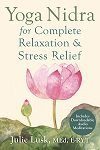 Yoga Nidra can stop tension in its tracks with a wonderfully, powerful & unique state of deep relaxation, mental clarity & insightful awareness.
These practical, empowering relaxation exercises, meditations that soothe and visualizations that renew are based on classic yoga and backed by modern science. They’ll help you unwind, replenish, and feel refreshed with durable peace and unconditional joy.
CLICK the blue title link above to find out more...
Yoga Nidra can stop tension in its tracks with a wonderfully, powerful & unique state of deep relaxation, mental clarity & insightful awareness.
These practical, empowering relaxation exercises, meditations that soothe and visualizations that renew are based on classic yoga and backed by modern science. They’ll help you unwind, replenish, and feel refreshed with durable peace and unconditional joy.
CLICK the blue title link above to find out more...
Yoga Nidra Essentials CD Find your calm spot. Brighten your energy. Enjoy a more meaningful life. Experience 6 levels of relaxation. Reclaim optimal health for your body, mind & heart. Laura says "My focused mind easily. I was 100% worry-free. It's wonderful." By Julie Lusk, 6-time author. Digital downloads available.
Author: Julie Lusk, M.Ed., E-RYT 500

Wellness goes far beyond the freedom from illness. It emphasizes each individual’s uniqueness along with the importance of self-responsibility and a positive attitude for personal well being.

They are Social, Physical, Intellectual, Career, Emotional and Spiritual health and well being. Each dimension is equally important to living a well-rounded, successful life. Paying equal attention to each aspect by developing and balancing them throughout life is important and results in wholesome living which is stimulating, productive and vital.
The Hurricane Katrina Resiliency Project is using SPICES for Life as a wellness and stress management tool for mental health professionals associated with recovery efforts. Workshops are being held in New Orleans starting in the fall of 2007. (Yes, recovery efforts are will underway).
Michigan State University College of Human Medicine is using the SPICES concept and acronym in a comprehensive health and wellness resource guide for all incoming first-year medical students starting in the Fall of 2007.
Thomas M. Wolf wrote about SPICES for Life in his book: To your Health: Achieving Well-Being during Medical School.
Additionally, SPICES for Life can also provide a structure for a well rounded employee wellness program. Ideally, this format starts with an introductory session which trains participants on the concepts and advantages of professional and personal well being and motivates them to pursue lifestyle improvements. Sessions on each wellness dimension follow to further understanding and prompt individual lifestyle changes that are positive in nature. Each session will help participants:
→ Julie Lusk, M.Ed. is available to speak about SPICES for Life ® and a variety of wellness and mind/body topics at your special event.
