Mindfulness Meditation Warnings & Alerts
Julie Lusk, M.Ed., NBCC, E-RYT-500
Wholesome Resources for Mind-Body Mastery through Yoga, Meditation, Guided Imagery, Stress Relief, Wellness


 Online Yoga Nidra Class Attend class on Zoom plus get 2 weeks of unlimited streaming of class replays. Register below.
Yoga Nidra is yoga sleep. It can totally relax and put your physical, mental, and emotional stress to rest. It’s practiced either lying down in the relaxation pose (savasana) or in a comfy chair. No other yoga postures are needed.
 Register below for single classes or by the month
Get replays for 14 days of unlimited streaming.
Mondays from 7-8:30 pm (ET) ~~
June | 1. 8. 15. 22 | Registration is open
July | 6. 13. 20. 27 |
Aug | 3. 10. 17. 24 |
More | TBA
All classes and plans include class audios at no extra charge (attendance not required). Recordings are emailed to everyone within 48 hours after class for 14-days of unlimited streaming for personal/non-commercial use. Downloads of your favorite classes are available to buy for keeps.
Choose from the weekly or monthly plan below. Use the CART to review your order & check out. Use the cart in the menu bar above or scroll down.
Monthly plan for $50 – Save $30
4 classes held per month

Single class for $20 each


The one thing we all have in common is to find happiness. Here are the 4 keys to unlock happiness. They are from Patanjali’s Yoga Sutra 1.33.
The 4 Keys to Happiness
~ Patanjali’s Yoga Sutras 1.33 ~
The mind becomes peaceful and free when the qualities of the heart are cultivated.
These qualities are:
Friendship toward the joyful,
Compassion toward the suffering,
Happiness toward the pure, and
Undisturbed toward the impure.
Click for a guided yoga nidra meditation
focusing on the
4 Keys to Happiness.
Sri Swami Satchidananda helps us better understand what Patanjali is conveying in his booklet, Integral Yoga: The Yoga Sutras of Patanjali (Pocket Edition). On pages 16-19, he writes:
“Whether you are interested in reaching samadhi or plan to ignore Yoga entirely, I would advise you to remember at least this one Sutra. It will be very helpful to you in keeping a peaceful mind in your daily life. In my own experience, this Sutra became my guiding light to keep my mind serene always.
Patanjali gives us four keys: friendliness, compassion, delight, and disregard. There are only four kinds of locks in the world. Keep these four keys always with you and when you come across any one of these four locks you will have the proper key to open it.
When you see a happy person, use the “friendliness” key. Why should Patanjali say this? Because even four thousand years ago there must have been people who were not happy at seeing others happy. It is still the same way. Suppose somebody drives up in a big car, parks in front of his huge palatial home and gets out. Some other people are standing on the pavement in the hot sun getting tired. How many of those people will be happy? Not many. They will be saying, “See that big car? He is sucking the blood of the laborers.” We come across people like that. They are always jealous. When a person gets name, fame. or a high position, they try to criticize him. “Oh, don’t you know, his mother is so-and-so; she must have pulled some strings somewhere.” They will never admit that he might have gone up by his own merit. By that jealousy, you won’t disturb him, but you will disturb your own serenity. He simply got out of the car and walked into the house, but you are burning up inside. Instead, think, “Oh, such a fortunate man. If everybody were like that how happy the world would be. May God bless everybody to have such comfort. I will also get that one day.”
Make them your friend. That response is missed in many cases, not only between individuals but even among nations. When some nation is prospering, the neighboring country is jealous of it and wants to ruin its economy. So we should always have the key of friendliness when we see happy people.
And what of the next lock, the unhappy people? “Well, Swami said everybody has his or her own karma. This person must have done some wretched thing in her last birth. Let her suffer now.” That should not be our attitude. Maybe someone is suffering from previous bad karma, but we should have compassion. If you can lend a helping hand, do it. If you can share half of your loaf, share it. Be merciful always. By doing that, you will retain the peace and poise of your mind. Remember our goal is to keep serenity of our minds. Whether our mercy is going to help that person or not, by our own feeling of mercy, at least we are helped.
Then comes the third kind, the virtuous people. When you see a virtuous person, feel delighted. “Oh, how great she is. She must be my hero. I should imitate her great qualities.” Don’t envy the person; don’t try to pull them or her down. Appreciate virtuous qualities in that person and try to cultivate them in your own life. Look for noble qualities in everyone.
Lastly, the wicked. We come across wicked people sometimes. We can’t deny that. So what should be our attitude? Indifference. “Well, some people are like that. Probably I was like that yesterday. Am I not a better person now? He will probably be alright tomorrow.” Don’t try to advise him because wicked people seldom take advice. If you try to advise them you will lose your peace.”
Or that calm is retained by the controlled exhalation or retention of the breath. Yoga Sutra 1.34
Or engage the focus on an inspiring object. Yoga Sutra 1.35
Or by concentrating on the supreme ever-blissful Light within. Yoga Sutra 1.36
Or receive grace from a great soul. Yoga Sutra 1.37
Or reflect on a peaceful feeling from an experience, dream, or deep sleep. Yoga Sutra 1.38
Or dedicate yourself to anything that elevates and embraces your heart. Yoga Sutra 1.39
Integral Yoga: The Yoga Sutras of Patanjali (Pocket Edition). Translation and commentary by Sri Swami Satchidananda. Integral Yoga ® Publications. Buckingham, VA. 1985.
The Secret Power of Yoga. Nischala Joy Devi. Three Rivers Press. NY, NY. 2007.
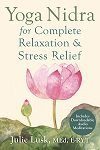
Yahoo! Yoga Journal has featured an excerpt from my latest book! Yoga Nidra for Complete Relaxation and Stress Relief (NHP 2015).
Easy Does It is a 10-minute relaxation practice to rest well and beat anxiety. During it, an inner sanctuary of peace and calm is quickly and easily achieved using relaxation techniques and guided imagery. Your personal sanctuary can also be recalled during stressful times to give you real relief.
You’ll also be able to enroll in Yoga Journal’s Yoga for Stress and Anxiety online course. It’s a six-week course that’ll make a lasting change in the way you work, love, and live.
Having and maintaining a good memory is an important ingredient that all of us need and want. Right? Many of us get concerned when forgetfulness happens to us or to those close to us. This is particularly troublesome as we age and especially if we have a family history of dementia or Alzheimer’s disease. Try the 12-minute meditation called Kirtan Kriya.
Here is an inspiring video with research to prove that there are easy things we can do for memory improvement with meditation.
Along with the conventional wisdom of good nutrition, supplements and mental and physical exercise, Dharma Singh Khalsa, MD says that meditation is key. A research study is reviewed that shows increases in brain development for memory, concentration and focus using a simple 12-minute meditation, including a yoga mudra.
The Kirtan Kriya – the Sa Ta Na Ma 12 minute meditation for memory is from the Kundalini yoga tradition. To get measurable results, it is done daily for only 8 weeks. But, who would want to stop there. Not me!
The Sa Ta Na Ma meditation technique also stops the mental chatter to bring about a clear mind. It’s calming too.
This NY Times article Yoga May Be Good for the Brain was published June 1, 2016 . It discusses a study in the Journal of Alzheimer’s Disease in April 2016.
A combination of 1 hour of weekly yoga exercise and a daily 15-minute Kirtan Kriya Meditation is recommended to help with memory improvement, concentration and mood improvement (depression). Improvements were also made in “visuospatial memory, a type of remembering that is important for balance, depth perception and the ability to recognize objects and navigate the world”. It was compared to another highly regarded brain training program practiced that was practiced for 1 hour weekly with 15 minutes of daily memory exercises.
The yoga + meditation group “topped the benefits of the brain training group” showing statistically significant results.
Sa Ta Na Ma
Kirtan Kriya Meditation
Click HERE to buy this downloadable digital album
(MP3, AAC, M4A)
$7.99
